If you’re like me, you’ve been irritated in the past by flashback scenes with unclear beginnings and endings… or worse, flashbacks that seem at first to have happened last week, but in fact happened 5000 years ago in the age of the Legendary Hero.

Insert Legendary Hero Here
Any time you use a flashback in fiction, you also introduce an opportunity for confusion.
So here are some tips I’ve collected for writing flashbacks clearly. To illustrate them, I’ve knocked off a scene in haste. And it probably shows. But at least it illustrates all the steps in turn.
Let’s assume you’re writing your story in past tense.
1) You can help to cue a flashback by giving a character’s mind the chance to wander.
On the way back from the station washroom, Detective Horton Locke peered out the narrow, triple-layered window of the fortress-type megastructure. Peachy sunlight shone through a tenuous spiderweb of cablecar lines, combing thin shadows against the vast habitat pylons of the megalopolis. The deadline was three hours away. The case was still unsolved.
He closed his crusty eyes, letting a hint of forbidden sleep tantalize his brain.
2) As you enter a flashback, use past perfect tense, and anchor the flashback with a CLEAR time marker:
He hadn’t felt this exhausted since three months ago at the air harbor, when he’d waited for Rosandre to arrive from Tsarmin Province. When she hadn’t showed up on the scheduled flight, he’d installed himself at a coffee kiosk, trying to read a novel.
3) Switch to simple past once the reader gets established:
But he never even got past page fifty. He ordered coffee after coffee, smoked lucifer after lucifer. He couldn’t allow himself to go to sleep. She might appear any instant, he told himself, materializing in the space where two other bodies parted like a curtain…
And he knew that at the moment she did appear, he would turn away, pretending not to see her — so that she would have to approach him.
4) As you exit the flashback, use past perfect again:
But he never got a chance to. For thirty-five solid hours, rocketship after rocketship had appeared on the display board, and Rosandre hadn’t been on any of them.
5) Optionally, use a move like “to this day”…
To this day, Locke knew nothing of where she had gone to — only that it wasn’t here, the city… and could he really blame her?
6) Re-anchor the reader to the original scene with a detail mentioned previously.
The morning sunlight hurt his eyes. Locke smeared his hand across his face and went back to his desk, to the case.
There had to be a connection he was missing. Some angle, some connection that would to explain the bizarre disappearance of the rock star Ranjan Thrust, the mysterious sandalwood box full of dried jellyfish stingers sent from House Nouelles, his boss’s unforeseen demand that he solve the case by noon or face suspension… but what?
Of course, using the same principles, you can also pull off more complicated tricks….
Let’s look now at a scene from Philip K. Dick’s Now Wait for Last Year, in which a flashback is INTERCUT WITH THE PRESENT. Here, POV character Eric is discussing his past with UN dictator Gino “The Mole” Molinari.

Dick manages this trick by mostly restricting the flashback to the past-perfect tense and the ongoing scene to the simple past. I’ve used boldface text to emphasize verb tense in this extended quotation.
Actually, in his case it had been a very small matter. Something which if told — and he had never been so foolish as to tell it, even to his professional headbasher — would have proved absurd, would have made him appear, and rightly so, an idiot. Or, even worse, mentally deranged.
It had been an incident between himself and—
Now the simple past tense intrudes:
“Your wife,” the Mole said, staring at him, never taking his eyes from him. And still the steady grip of his hand.
“Yes.” Eric nodded. “My Ampex video tapes… of the great mid-twentieth century comedian Jonathan Winters.”
For a while, Dick strictly alternates between past and past perfect to keep things clear.
The pretext for his first invitation of Kathy Lingrom had been his fabulous collection. She had expressed a desire to see them, to drop by his apt — at his invitation — to witness a few choice shots.
The Mole said, “And she read something psychological into your having the tapes. Something ‘meaningful’ about you.”
“Yes.” Eric nodded somberly.
After Kathy had sat curled up one night in his living room, as long-legged and smooth as a cat, her bare breasts faintly green from the light coating of polish she had given them (in the latest style), watching the screen fixedly and, of course, laughing — who could fail to? — she had said contemplatively, “You know, what’s great about Winters was his talent for role-playing. And, once in a role, he was submerged; he seemed actually to believe in it.”
“Is that bad?” Eric had said.
Now that the flashback scene has been going on for a while, Dick reverts to the simple past for a few verbs, but includes a past-perfect verb for good measure:
“No. But it tells me why you gravitate to Winters.” Kathy fondled the damp, cold glass of her drink, her long lashes lowered in thought. “It’s that residual quality in him that could never be suppressed in his role. It means you resist life, the role that you play out — being an org-trans surgeon, I suppose. Some childish, unconscious part of you won’t enter human society.”
“Well, is that bad?” He had tried to ask jokingly, wanting — even then — to turn this pseudopsychiatric, ponderous discussion to more convivial areas… areas clearly defined in his mind as he surveyed her pure, bare, pale-green breasts flickering with their own luminosity.
“It’s deceitful,” Kathy said.
As he leaves the flashback, Dick again uses past-perfect, emphasizing the transition to the present with “now.”
Hearing that, then, something in him had groaned, and something in him groaned now. The Mole seemed to hear it, to take note.
Flashback time control can be tricky, but by following these tips, you may find it easier. See you Monday!
Filed under: STRUCTURE | Closed
Tags: flashbacks, philip k dick
One of the things I keep learning as I write is how important it is not to mistake your own emotions for your readers’ emotions as they react to your story.
Late in 2008, after what seemed like an unbelievable amount of planning & continuity problems, I finished a draft of a novel and went out and celebrated. Every emotional beat seemed to be in place; the feeling of an ending was there; I was sure I’d hit it out of the park. It was a PERFECT ending.
When I showed the draft to my best friend, he wrote “STAKES” on the final page.

what is this storyline bro
I had mistaken my own emotions at finally finishing the goddamn draft, for the reactions I could expect my readers to have when they finished reading it.
This error didn’t happen entirely out of vanity — after all, when don’t we estimate other peoples’ emotions by means of our own? — but it’s still a mistake many are capable of making.
To see if you’re vulnerable to it, try an experiment.
First, buy a handle of cheap whiskey.

Start drinking it neat, alone in an empty room, preferably while listening to Joy Division’s “Ceremony” on repeat loop.
Begin reflecting on all your most personal regrets and failures — all those embarrassing moments that seem to symbolize the moments you lost any hope of achieving a normal life. Think about how you can’t seem to really connect with people. About all the wickedest parts of you, and how trying to own them only seems to give their existence more power over you. Not to mention how when you care about something, you usually fuck it up somehow. Yeah, that too… When you come right down to it, aren’t you a pretty inadequate excuse for a healthy human being?
image of existential despair
Now, project all those emotions of rage and hate onto a character. Get angry at them, really throw yourself into it, don’t censor anything, just write out all the angst…
Now, to make matters worse, keep endlessly rewriting the scene and amping up the language, until either you purge yourself of those emotions, or pass out on your keyboard.
What you read the next morning… or more likely the next afternoon… won’t be pretty.
More than likely, it also won’t be effective as fiction.
typical reaction to overwritten angst
It’s not exactly that when we get worked up (or fucked up) we lose our “objective” sense of the text. That objectivity is certainly an illusion.
Rather, I think it’s that we lose any sense for what actually works on the page, and mistake what we’re pouring into the text for what readers get out of it.
His nerves took in the miserable notes, the vulgar crooning melodies; for passion lames the sense of discrimination, and surrenders in all seriousness to appeals which, in sober moments, are either humorously allowed for or are rejected with annoyance.
– Thomas Mann, Death in Venice
There was truth to H. L. Mencken’s statement that the pleasure to be gotten out of Il Trovatore can be doubled with a few shots of rye. But it’s not fair to require that your reader be drunk off their ass to enjoy your story.
Reading fiction isn’t an act of telepathy between the writer and the reader. Words simply don’t “convey emotions.” It’s a two-way process.
You could even say that reading fiction is kind of like performing a divination:
The emotional charge in your question is the energy that activates the archetypal images in the answer.
-Eranos I Ching, Introduction
Although you can’t expect to micro-manage your reader’s emotions, I think the best you can hope to do is to provide a framework of stimuli through which they might have some emotional experience.
Just know that it probably won’t be the same as yours.
Filed under: ANALYSIS, CHARACTERIZATION, EXPOSITION, VIEWPOINT, WRITING PRACTICE | 3 Comments
Tags: angst, i ching, Thomas Mann
Heroes vs Characters
People often talk about round vs flat characters, dynamic vs iconic characters.
Instead, today, I want to ramble a little bit about another distinction — a distinction, you might say, between archetypal heroes and distinct characters.
I’m not trying to make this the Grand Unified Theory of all fiction here, just pointing out something interesting that I’ve seen happen in popular books and movies.
If you can get past the tasteless and misogynistic humor used to frame the videos, one of the best ways to waste an hour on the internet is to watch Red Letter Media’s 7-part review of Star Wars: Episode 1. There’s a lot of really good storytelling analysis here.
Today’s blog entry is going to pivot off of the section that begins at about 06:48 of the first video, where guests compare Original Trilogy characters and Prequel Trilogy characters.
If you don’t care to watch, here’s a transcript:
Describe the following Star Wars character WITHOUT saying what they look like, what kind of costume they wore, or what their profession or role in the movie was.
Describe this character to your friends like they ain’t never seen Star Wars.
The more descriptive they get, the stronger the character, right?

Han Solo:
“He’s a rogue”
“He’s very arrogant, but charming”
“Roguish, if you will”
“Han Solo is… totally dashing <3”
“Wannabe dashing, he fancies himself as a playboy”
“So, like, he’s a smarmy cocksure womanizer”
“Scoundrel”
“Pigheaded”
“Completely sexy in like a bad boy sorta way where, like, he’s gonna ride the line”
“He’s got kind of a dark streak to him, with shooting Greedo in the bar”
“But also, deep down, he’s a thief with a heart of gold, that’s his character, really.”
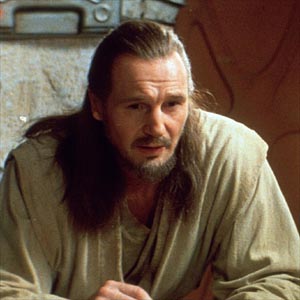
Qui-Gon Jinn:
“He’s……. stoic”
“I don’t remember that character.” (OK, he’s Liam Neeson, with the beard?) “Oh… yes..”
“……Well, he has a beard.”
“Qui-Gon Jinn, and he was……..?”
“Bahaha!!!…. um…. stern?”

C-3P0:
“Bumbling sidekick”
“Scaredy-cat… timid”
“C-3P0 is… anal-retentive—”
“—is prissy”
“Used a lot as comic relief—”
“—High-strung”
“—He’s bumbling… effeminate”

Queen Amidala:
“That is going to be fucking impossible because she doesn’t have a character”
“She is, um………. she’s Natalie Portman?”
“Yeah, like, just, kind of…”
“She’s a queen…”
“Normal, I guess. She’s kinda normal.”
“Makeup would be a description, I was gonna describe her makeup.”
“Um… monotone?”
“I can’t answer that and you know it!”
“So….”
“She is…. this is funny, btw”
This storytelling exercise makes it clear that Han Solo and C-3P0 are way more dynamic and memorable than these newcomers.
My question, though, is —- why didn’t Red Letter Media ask about Luke Skywalker, who is after all the main fucking character in Star Wars?

Hey guys, what about me?
Let’s compare:
- When you describe Batman Returns, are you more likely to call it, “the one where Batman is framed for murder” or “the one with Catwoman and The Penguin?”
- Why is the typical JRPG protagonist silent, while supporting characters get dialogue?
This is the distinction I want to make:
In almost every case, when you compare the main character of a story with a main supporting character, the supporting character is cooler, more quotable, vivid, and (sometimes) even more popular!
I think the main characters of stories like these don’t really deserve to be called characters. They’re really just heroes, full stop: indistinct surfaces onto which viewers can project themselves.
And as we all know, blank surfaces are best when it comes to projection.
You might have noticed these characters are also male… I wonder why LOL. Nevertheless, female versions exist…
as pale as a movie screen
I got thinking about this dichotomy when I read an interesting line in Gregory Barrett’s Archetypes in Japanese Film:
Characters are the constituents of realistic drama and literary art. Archetypes are the stuff fantastic entertainments and commercial films are made of.
Similar to this is a comment Susan Sontag made in Thesis 33 of Notes on Camp:
…Wherever there is development of character, Camp is reduced. Among operas, for example, La Traviata (which has some small development of character) is less campy than Il Trovatore (which has none).
It sometimes seems that the campier the entertainment, the less character development becomes possible for the hero.
You could even say that the Campbellian Heroic Journey — the basic story structure we all know from Star Wars, the Matrix, etc, including the figure of the ‘chosen one’ — is specifically set up to use spectacular events as a substitute for character development.
Any time a character hears a prophecy or “finds out about their destiny”, say goodbye to nuanced character analysis and say hello to spectacle.
I even think this distinction between nuanced character and heroic archetype can help explains why certain literary techniques fall flat for me.
To me, Ayn Rand’s mode of “romantic realism”, featuring larger-than-life capitalist heroes that represent (as she put it) “man as he should be”, ends up being just as turgid as works of Socialist Realism, which, you might say, tried to represent “Russia as it should be.”
Although their political philosophies were diametrically opposed, the artistic effect of both movements was equally poor.

Does this guy look like an interesting character to you?
I think this happened because the archetypal, audience-surrogate, wish-fulfillment heroes in these stories are incompatible with the level of psychological analysis that their own creators tried to milk out of them.
Rand, like the socialists she detested, believed that her ideology was the only accurate way to view the world.
Yet just like the socialists, when she tried to subject her own heroes to analysis, the effect failed. The characters were too heroic and perfect to seem real when viewed in detail.
So… the more popular the entertainment, the blanker the main character? Are things really this bleak?
When we try to create compelling main characters, it’s easy to use audience projection as a substitute for character development and default to the “chosen one” type hero.
The challenge is to achieve audience identification without relying on the “projection effect” that makes Neo, Luke, and Paul Atreides so goddamn boring.
For me, the mark of a high-quality story is when the main characters admit some degree of audience identification, but are nevertheless unique and psychologically nuanced. These individuals may develop in more ambiguous directions than the archetypal hero.
For me, Alfred Bester’s Gully Foyle, Gene Wolfe’s Severian, and Charlotte Bronte’s Lucy Snowe all fall into this category.
Luke Skywalker, not so much.
Filed under: CHARACTERIZATION | 5 Comments
Tags: ayn rand, batman, dune, harry potter, lord of the rings, socialist realism, Star Wars, susan sontag, the matrix
Parallel Structures
Today I’m just going to present 4 quick examples of a device you can use to delight your reader. I’m sure there’s some kind of classical rhetorical term for this, but I don’t know it.
I just call it a sentence with parallel structures: a sentence where a statement is made, then repeated with the terms reversed or modified.
Like this!
“To think that tonight, for the sake of a woman I don’t love, I’m going to murder a man I don’t hate!”
–Akutagawa Ryūnosuke, “Kesa and Morito,” in The Essential Akutagawa

Or like this…
The ponytailed girl twitched her mouth. “I can’t believe your mouth is even more powerful than your dagger.”
Li Xun Huan said, “Really?”
The ponytailed girl said, “Although your dagger can take a man’s life, your words can take a lady’s heart. Don’t you think that it’s much harder to receive a woman’s heart than a man’s life?”
With those big eyes looking at him, even Li Xun Huan could not help but feel drawn towards her. He never thought this young girl can be so intimidating.
Gu Long is very good at using this device:
“Although you know very little, you’ve said way too much,” ShangGuan JinHong said.
Of course it’s sometimes used for more highbrow ironies:
Catholics believe in an ultraterrestrial world, but I have noticed that they are not interested in it. With me the opposite occurs: I am interested but I do not believe.
–Jorge Luis Borges, Selected Nonfictions, review of Leslie Weatherhead’s After Death
young Borges as hottie

Why are these lines so delightful? (Am I the only one who thinks so?)
Filed under: DIALOG, WRITING STYLE | 2 Comments
Tags: akutagawa ryunosuke, borges, Gu Long, wuxia
Measurement in Secondary Worlds
I just wanted to throw out a link to a good article dealing with a question that plagues writers of secondary-world fantasies: how to deal with units of measurement?
http://talktoyouniverse.blogspot.com/2012/03/measurement-questions-in-sff-and.html
Filed under: Uncategorized | Closed
Tags: measurement
 SpecTechnique