When Empty Things Aren’t Empty
The opposite of existence is not nonexistence, but insistence: that which does not exist, continues to insist, striving toward existence… When I miss a crucial ethical opportunity, and fail to make a move that could ‘change everything’, the very nonexistence of what I should have done will haunt me for ever: although what I did not do does not exist, its spectre continues to insist.
– Slavoj Žižek, Welcome to the Desert of the Real
Today at Spectechnique the topic is “when empty things aren’t empty.”
I want to start off w/ a video of a certain Slovenian philosopher beloved by grad students the world over:
Money quote:
The hero visits a cafeteria and orders coffee without cream. And here is the wonderful reply of the waiter: “Sorry, we have run out of cream, we only have milk. Can I then bring you coffee without milk?”
Coffee without cream and coffee without milk are chemically the same substance, but philosophically, they’re no longer the same thing.
As Žižek puts it,
What you don’t get is part of the identity of what you do get.
As speculative fiction writers, we need to remember to show our characters thinking this way too. Because what’s not present in their selections can say a lot about them and about their setting.
“A cheeseburger, please — no fries, no ketchup. What? No, no soda either, thanks”
A phone that lacks a touchscreen or a camera or 4G connectivity.
“I’ll take a Bloody Mary, hold the blood.”

If you’re fond of using jargon in your future settings, you can also this device to subtly hint at what your made-up products actually do.
He slapped a caffeine-free stimpatch to his shaven scalp and took a deep breath.
In language, 0 +1 – 1 never quite equals 0 again…. just as X + 0 never quite equals X.
What I mean by this is that many commonly used idioms are “empty” in terms of logical content. They add no propositional meaning to the sentence, but they have so many extra valences and connotations that we find them indispensable. Here are just a few.
It is what it is.
I’m just saying…
If it’s not one thing, it’s another.
That’s really something.
There’s no time like the present.
Last, I want to present a technique that’s kind of the opposite of the “coffee without cream” technique. You could call it a kind of false reassurance, or a reassurance that does the opposite. The quote comes from “Sarrasine,” a second-tier Balzac short story.
Having been greated warmly enough by most of those present, whom he knew by sight, he sought to approach the armchair on which La Zambinella was casually reclining.

Commentary from S/Z, Roland Barthes’s structuralist analysis of the story:
Sarrasine is greeted warmly enough — a curious qualifier: by reducing a possible extremely or very, it reduces the positive itself: these warm enough greetings are actually something less than warm, or, at least, warm with embarrassment and reticence.
From a naive point of view, being greeted “warmly enough” might seem okay; since you get the warmth that you expected, nothing has really gone wrong.
Right…?
COME ON!!! Do you really to hear your boss say that your work is “good enough,” or for your sweetheart to embrace you “passionately enough,” or go to a restaurant where the food is “tasty enough”? I should hope not!
In fiction, not only are empty things not empty — when we insist that they’re definitely full, they mysteriously get a little bit emptier.
Maybe this is why understated emotional beats are almost always more convincing than bombastic ones…? Hmmmm, wonder if there’s an article in this….
Anyway, visit SpecTechnique tomorrow for an article about the device of cutting to the present tense in a past-tense story. See u later #nerds …
Filed under: ANALYSIS | 1 Comment
The “Time Ratio” of an Action Scene
or,
J.G. Ballard vs Gu Long: FIGHT!
On Friday at SpecTechnique we looked at Gu Long’s action writing and saw how he brought us into the POV of the spectators, forcing the reader to reconstruct Li Xun Huan’s impossibly fast dagger throw from the clues on the page.
Today we’re going to look at a scene that does the exact opposite — the part in J.G. Ballard’s Crash where the POV character watches a slow-motion test film of an automobile colliding with a motorcycle.
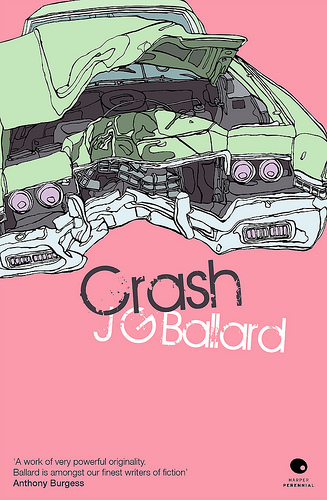
Whereas Gu Long omitted action, Ballard uses the slow-motion film as an excuse to lovingly describes more action than an unaided human eye could ever perceive.
And here it is.
Beside the Ampex machine the visitors were watching the motorcycle as it crashed once again into the saloon car. Sections of the collision were replayed in slow motion. In a dream-like calm, the front wheel of the motorcycle struck the fender of the car. As the rim collapsed, the tyre sprung inwards upon itself to form a figure of eight. The tail of the machine rose into the air. The mannequin, Elvis, lifted himself from his seat, his ungainly body at last blessed by the grace of the slow-motion camera. Like the most brilliant of all stunt men, he stood on his pedals, legs and arms fully stretched. His head was raised with its chin forwards in a pose of almost aristocratic disdain. The rear wheel of the motorcycle lifted into the air behind him, and seemed about to strike him in the small of the back, but with great finesse the rider detached his feet from the pedals and inclined his floating body in a horizontal posture. His hands were still attached to the handlebars, now moving away from him as the cycle somersaulted. The metering coils severed one wrist, and he launched himself into a horizontal dive, head raised so that his face became a prow, bearing its painted wound areas towards the oncoming windshield. His chest struck the bonnet of the car, grazing its polished cellulose like a surfboard.
Already, as the vehicle moved back under the impact of the first collision, the four occupants of the car were themselves moving towards the second collision. Their smooth faces pressed on into the advancing windshield as if eager to see the chest glider soaring up the bonnet of the car. Both the driver and his woman passenger rolled forwards to meet the windshield, touching it with the crowns of their lowered heads at the same moment as the motorcyclist’s profile struck the glass. A fountain of spraying crystal erupted around them, through which, as if in celebration, their figures were taking up ever more eccentric positions. The motorcyclist continued on his horizontal path through the emblazoned windshield, his face torn away by the centrally mounted driving mirror. His left arm detached itself at the elbow as it struck the windshield pillar, and was swept up through the fountain of glass to join the debris chasing the inverted body of the motorcycle three feet above his spine. His right arm moved through the fractured windshield, losing first its hand on the guillotine of the near-side windshield wiper, and then its forearm against the face of the front-seat woman passenger, taking with it her right cheekbone. The motorcyclist’s body slewed gracefully to one side in an elegant slalom, his hips striking the right-hand windshield pillar, buckling it at the central welding point. His legs rotated around the car, shin-bones striking the central door pillar.
Above him, the inverted motorcycle fell on to the car’s roof. Its handlebars passed through the empty windshield and decapitated the front-seat passenger. The front wheel and chromium fork assembly plunged through the roof, the whiplashing drive chain severing the cyclist’s head as he swept past. The pieces of his disintegrating body rebounded off the rear wheel-housing of the car and passed over the ground in the haze of broken safety glass which fell like ice from the car, as if it had been defrosted after a long embalming. Meanwhile, the driver of the car had rebounded off the collapsing steering wheel and was sliding beneath the column into the lower compartment of the car. His decapitated wife, hands raised prettily in front of her neck, rolled against the instrument panel. Her detached head bounced off the vinyl seat covering and passed between the torsoes of the children in the rear seat. Brigitte, the smaller of the two children, lifted her face to the roof of the car and raised her hands in a polite gesture of alarm as her mother’s head struck the rear window and cannonaded around the car before exiting through the left-hand door.
The car slowly came to rest, continuing to heave itself laboriously off the ground. The four passengers subsided into the glass-embroidered cabin space. Their signalling limbs, busy with an encyclopedia of unheeded semaphores, settled again into a crudely human posture. Around them, the fountain of frosted glass moved away for the last time.
-J.G. Ballard, Crash
hipster kitty reveals a fault in his erudition
Rather than pick apart this scene for rhetoric, style, etc — I want to talk instead about a feature of the text you might not expect me to mention in a discussion about the style of action writing.
And yet, in a passage this long, it’s the most noticeable feature of all.
I’m talking about its word count.
This excerpt lasts for 724 words, or about three typeset pages.
According to Wikipedia, the average American adult reads prose at 250-300 words per minute.
This means that it takes the average American reader two or three minutes just to read this car crash — a crash that, in “real time,” would take only two or three seconds.
Therefore, we can estimate that the ratio between the time it takes us to read the scene, and the time the original crash would’ve taken to occur before the cameras slowed it down, is about 60:1.
From now on, I’m going to refer to this ratio as the Time Ratio of an action scene.
Time ratio = Time to read : Time it would take to happen
(Obviously, the time ratio will vary for every reader. People who savor every syllable will experience the text as “slower,” while skimmers will fly through the scene. For the sake of argument I’m using the 250 WPM average.)
Now, let’s look back at to yesterday’s example:
Just as everyone thought this sword would penetrate the youngster’s heart, Zhu Ge Lei suddenly give a loud yell, his sword left his hand, stuck on the ceiling.
As the sword still springs back and forth on the ceiling, Zhu Ge Lei’s hands are already grabbing his own throat. But his eyes are on Li Xun Huan, the eyeballs almost popping out.
Li Xun Huan at this moment is no longer carving. Because the dagger he used to carve the figure is no longer in his hand.
Blood trickled from Zhu Ge Lei’s back.
He stared at Li Xun Huan, his throat also giving off a ‘ge ge’ sound. It’s only at this time that people began to understand that Li Xun Huan’s carving dagger made its way to Zhu Ge Lei’s throat.
Yet no one saw how this dagger got to his throat.
This passage is just 144 words long. Assuming a 250-300 WPM reading speed, the average American will read it in about 30 seconds — probably less, since unlike the Ballard passage it has no figurative language or rhetorical devices.
For the purposes of argument, let’s also say these events (thrown dagger, ZGL reacts, crowd finally gets it) take five seconds of “real time” to happen.
This would mean that the Time Ratio of our Gu Long example is something like 6:1. That’s about ten times faster than Ballard — but it’s still slower than reality.
Nevertheless, because Gu Long omits the attack itself, the action still feels blazingly fast!
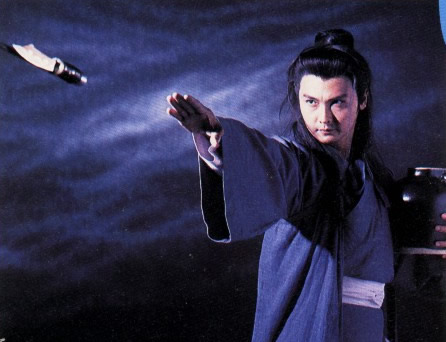
A sequence written “naively” at 6:1 would probably feel a lot slower. I think that here, Gu Long is able to overcome a slow time ratio by the use of swift, cunning action devices.
What would a 1:1 sequence look like? If you’re an “average” reader, here’s a twelve-word example:
For three seconds, she smoked and stared into the darkness of space.
If you’re a fast reader:
For two seconds, she smoked and stared into the vastness of space.
If you’re a speed-reader:
She spent less than a second staring into the blackness of space.
Interestingly, whether two characters’ dialogue seems snappy or plodding, it’ll almost always be read faster than the characters could ever speak it! While the average reading speed is 250-300 WPM, conversational speech only happens at 150 WPM or so.
As a result, its Time Ratio might be like 1:1.5 — or even 1:2, if characters are really hemming and hawing. However, descriptive passages and internal monologue can expand word count without appreciably extending the time it would take for the scene to “play out”. This would push the ratio closer to 1:1, the scene that (for a certain reader) reads precisely as fast as it happens.
(Aside: I also wonder whether certain readers’ taste or distaste for certain writers has to do with the “time ratio” of their writing style. Speed-readers might think Writer Z’s scenes end unrealistically quickly, while slow readers might think Writer Y’s scenes always proceed slower than reality. Who knows?)
I intend to blog more about the “Time Ratio” in fiction because I think it’s cool, although obviously it can’t explain everything. The other stylistic devices of an action passage, such as Gu Long’s omitted attacks, still contribute heavily to the reader’s impression of speed. But I have a feeling that there are some wicked effects available to the writer who becomes conscious of this ratio and learns to manipulate it.
See you next time on SpecTechnique, where we’ll be talking about how empty things in fiction aren’t really empty.
Filed under: ACTION, STRUCTURE | Closed
Tags: action sequences, action writing, Gu Long, j g ballard, new wave, wuxia
Wuxia Action Timing
or,
Why Gu Long’s Writing Technique Shakes the Martial World
This fight class will be swift and ruthless, when you’re done reading you’ll all be experts.
All I want u to know about Wuxia right now is that it’s Chinese fiction featuring badasses in combat. I’ve been interested in it since I watched the Legend of the Condor Hero show in anime club in college.
Then I found about Wuxiapedia and spent many delighted hours poring over plot twists in translation. I’m still convinced that wuxia writers, because of their need to show amazing martial arts credibly, have developed/discovered some of the best ways of writing action scenes.
Gu Long is my favorite wuxia writer because of his stories’ mysterious twists and snappy dialogue, & because you don’t need to know a shit-ton of Chinese history to understand what’s going on (unlike, say, with Jin Yong.)

Gu Long, wuxia mastermind
That’s why I’ve been waiting for a long time to write a post about my favorite Gu Long novel, Sentimental Swordsman, Ruthless Sword, which you can find in fan translation here.
What’s this novel about? Wiki excerpt:
Duoqing Jianke Wuqing Jian (多情劍客無情劍; literally: Sentimental Swordsman, Ruthless Sword) is the first novel in the series, first published in 1968. It details the adventures of Li Xunhuan and his friend A’fei.
Li Xunhuan rises to prominence as a pugilist in the jianghu for the expert use of his signature weapon, the Little Li Flying Dagger. He is in love with Lin Shiyin but decides to give up on her to repay his sworn brother Long Xiaoyun’s kindness towards him. Long Xiaoyun marries Lin Shiyin eventually.
Li Xunhuan retires from the jianghu for the next ten years after being hurt emotionally. When he comes out of his reclusive life ten years later, he meets A’fei and befriends him. Both of them are drawn into the mysterious Case of the Plum Flower Bandit and Li Xunhuan is wrongly accused of being the bandit. He clears his name eventually. Meanwhile, he is also drawn into the complex feuds between Lin Xian’er, Shangguan Jinhong and Long Xiaoyun.
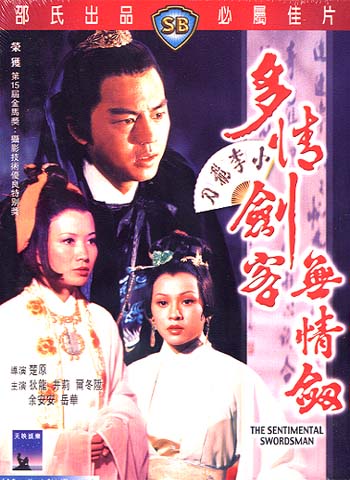
Because wuxia is relatively unknown to english-speaking audiences, I’ll include the intro so you can get a sense for what kind of style we’re dealing with here
Excerpt from chapter 1, “Flying Dagger vs Quick Sword” (Tense & verb problems are due to the UNPAID fan translator, so ignore ’em unless you can provide a superior translation!):
The cold wind act as a knife, using the ground as the cutting board, and people as fish meat.
The snowstorm extends for thousands of miles, making everything seem like bright white silver.
In this cold winter snowstorm, a horse carriage came from the north. Its wheels shattered the snow on the ground, but cannot shatter loneliness in the world.
Li Xun Huan yawned, trying to stretch his legs. The inside of the carriage might be quite comfortable, but this trip is just way too long, too lonely.
He feels not only exhausted, but also irritated. He feels that loneliness is the biggest annoyance in his life, yet loneliness frequently accompanies him.
A person’s life is usually filled with contradictions. No one can do anything about this.
Li Xun Huan sighed and took out a wine bottle. As he’s drinking the wine, he also begins to cough. His continuous coughing made his pale face appear very sick, as if fire from Hell is burning his flesh and soul.
The wine bottle is empty now, so he grabbed a little dagger and start to carve a wooden human figure. The dagger is thin and sharp, his hand is long and powerful.
The figure is that of a woman, so beautiful and warm under his masterful carving, looking so full of life.
He not only gave her a striking look, but also gave her life and soul, only because his life and soul is already quietly disappearing under the tip of the dagger.
He’s no longer young.
Wrinkles filled the corners of his eyes, every wrinkle filled with all the joy and sadness in his life. Only his eyes are young.
This is a strange pair of eyes, a shade of green, similar to the Spring wind blowing on the Willow leaves, warm and flexible. Or similar to the sea water under the Summer sun’s light, filled with energy.
Maybe it’s only because of this pair of eyes that allowed him to live till today.
As you can imagine, Li Xun Huan knows kung fu, and what’s more, he’s rated at a top level in the martial world thanks to his signature move, “Little Li’s Flying Dagger.” ❤
Today we’re looking at the moment when that extraordinary attack makes an appearance. Context: Zhu Ge Lei, bad guy of the moment (soon to be replaced by 100+ others) is about to attack the wild youngster Ah Fei.
Just as everyone thought this sword would penetrate the youngster’s heart, Zhu Ge Lei suddenly give a loud yell, his sword left his hand, stuck on the ceiling.
As the sword still springs back and forth on the ceiling, Zhu Ge Lei’s hands are already grabbing his own throat. But his eyes are on Li Xun Huan, the eyeballs almost popping out.
Li Xun Huan at this moment is no longer carving. Because the dagger he used to carve the figure is no longer in his hand.
Blood trickled from Zhu Ge Lei’s back.
He stared at Li Xun Huan, his throat also giving off a ‘ge ge’ sound. It’s only at this time that people began to understand that Li Xun Huan’s carving dagger made its way to Zhu Ge Lei’s throat.
Yet no one saw how this dagger got to his throat.
Sweat poured down from Zhu Ge Lei, his face full of pain. Suddenly he bit his teeth, and pulled that dagger out of his throat. Then stared at Li Xun Huan, yelling, “I should’ve recognized that it was you!”
Li Xun Huan sighed. “Unfortunately, you only found out now, or you never would’ve attempted to do such a disgraceful act.”
Zhu Ge Lei did not hear these words. He’ll never be able to hear ever again.
Let’s now imagine a kind of artless, step-by-step paraphrase of the core action scene.
1) Zhu Ge Lei was about to thrust his sword into the youngster’s heart.
2 ) All of a sudden, Li Xun Huan stopped carving.
3) He threw the dagger he’d been carving with.
4) The dagger landed in Zhu Ge Lei’s throat.
5) Zhu Ge Lei yelled. His sword flew out of his hand and stuck onto the ceiling.
6) As it swung back and forth, Zhu Ge Lei grabbed his own throat.
7) His eyes were on Li Xun Huan, his eyeballs almost popping out.
8. His throat gave off a ‘ge, ge’ sound.
9.) Li Xun Huan’s throw had been so incredibly fast that it took the other people several seconds to realize what had happened.
What I’ve done here is I’ve reconstructed the fight events from the original paragraph and rewrtten them — in chronological order.
But in the original paragraph, their order is: 1, 5, 6, 7, 2, 8, 9.
Steps 3 and 4 are omitted; we don’t see the dagger thrown at all!
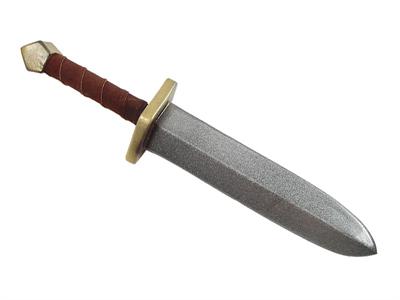
"Little Li's flying dagger, once released, never misses its target!"
What happened here? Wasn’t the whole point of action scenes to depict things……. happening?
Let’s look at the central bit, even closer now.
As the sword still springs back and forth on the ceiling, Zhu Ge Lei’s hands are already grabbing his own throat. But his eyes are on Li Xun Huan, the eyeballs almost popping out.
Li Xun Huan at this moment is no longer carving. Because the dagger he used to carve the figure is no longer in his hand.
To take it down one more level. Watch how the visual focus shifts:
sword on ceiling —-> ZGL —-> LXH emptyhanded
This action flow actually runs in reverse of the depicted events.
Here’s what actually happened:
LXH throws dagger to ——> ZGL, who loses sword —-> sword hits ceiling
Gu Long’s secret here is to frame the action from the POV of the observers themselves. What they’re seeing and what’s happening aren’t the same; they have to reconstruct the events of the fight from their own limited perceptions, tracing effects back to their causes, always a step behind.
Because Little Li’s Flying Dagger is so goddamn fast, these observers are condemned to always be a few steps behind the action! 😀
Check out 09:05ish for the filmed version of what happened here. But the novel is better…
Because I’ve got a soft spot for Ah Fei, here’s the ending to the chapter….
The youngster also turned to take a look, his face full of wonder, as if he’d never understand why this person would to kill him.
But he only looked for an instant, then walked up to Li Xun Huan. Beneath his wild and savage exterior seems to exist a hint of warmth and smile.
He only said one sentence. “I want to invite you for a drink.”
Join me on Monday at SpecTechnique when we’ll check out another, quite different method of doing action. The text will be J.G. Ballard’s Crash.
Filed under: ACTION, VIEWPOINT | 1 Comment
Tags: action scenes, action writing, Gu Long, legend of the condor hero, Little Li Flying Dagger, wuxia, Xiao Li Fei Dao
Everybody already knows what Hemingway said: all writers need a good bullshit detector. But what if I told you that all your characters needed good bullshit detectors too?
Okay, maybe that’s overstating things. Some characters need to be dense, always catching on last. Terry Bisson even wrote that it may help to make your POV character slightly stupid (see rule # 20) since this flatters the audience. But at the very least, I think it’s safe to say that when writing more perceptive characters, BS-checking is tool you need to know.
If you’re wondering what I mean by bullshit detection, take a look at the previous paragraph, where I examined and progressively reduced the overblown claim I made in the first.
U MAD BRO?
For me as a reader, when a character in a story BS-checks another person — or herself — I find it builds my trust in her POV.
The more I see her analyzing a shaky claim, the more I’ll believe in her powers of critical thinking.
The more honesty she demands from herself and others, the more I can believe that this POV character is reliable, rational, trustworthy…
And the more I may overlook it when the author tries to sell me a stretched metaphor, a suspicious solution, or a bogus “scientific” infodump!
Why is this effective at all?
Maybe when we see characters using critical thinking, we get the signal that hey, the pressure’s off now, somebody else is doing the bullshit checking for us, so we can just keep reading and enjoying the story faster and faster and faster.
(And maybe this also is one reason mystery novels tend to read so fast: since we trust that the detective is paying close attention to all the clues, we’re not afraid to miss a detail or three when reading. By contrast, it’s almost impossible to breeze through, say, a short story by Cortázar — if you miss a single detail you sense that you might not “get” what’s happening at all! I have to believe the differences are not only due to style.)
Okay, enough, how does this shit work in practice?

“The gods rebuilt me out of old bones and DNA and some sort of memory fragments they extracted from the bits they found on earth.”
“Memory from DNA?” said Mahnmut. “I don’t think so.”
I wave my hands impatiently. “It doesn’t matter,” I snap. “I’m the walking dead…”
Although I think Dan Simmons’ Ilium is a book with flaws — not the least of which is a severe lack of teh gay, which is a real problem in a book that’s supposed to be all about the Iliad, Shakespeare, and fucking Proust — this little moment had me cheering. Up to here there’d been all kinds of loose talk in the story about memory being encoded in genes. I was glad to see the adorable Moravec Mahnmut take that bullshit down.
Because Simmons acknowledged in his story that the memory-in-DNA idea was incorrect, I began to believe the setting more, even though no preferable explanation was offered in its place.
(It was probably some more nano-quantum-tunneling-parallel-multiverse-dead-white-author super science anyway lol…)
What Ilium needed more of
Here’s another example from (Clarion West alum!) David Herter’s “Black and Green and Gold,” a great story I found in Best New Horror 17.
On my wandering walk, I found myself at the grand concert hall on the Vltava — the Narodni Divadlo, or National Theatre. Glittering in green and gold, it projects a grandly linear profile amid all the baroque architecture, its rounded roofline like an elaborate cake festooned (there is no other word) with pickets of gold trim, and fronted with statues. The most prominent is a charioteer ready to launch his steeds into the sky.
When you write a word like “festooned”, eyes will almost always start rolling; sometimes this move is necessary to halt them before they can make a full revolution.
Likewise, Stendhal, whose lucid style never overstates the case, uses this device to conclude a summary in pt.2, ch.19 of The Red and the Black:
Mathilde’s reveries weren’t all as somber as the notions just transcribed; that must be conceded.
I think the category of bullshit-checking characters also extends to narrators who are aware of their own quirks and aren’t too uptight to own them. I love to read about characters like that. Here’s a fun one from Chris Beckett’s story “Picadilly Circus,” which I read in The Year’s Best Science Fiction 23:
…all I ever wanted was to be at home behind my high hedges that I had cut into the shape of castle walls, behind my locked doors, behind my tightly drawn curtains, writing about reality.
Finally, you can see Roberto Bolaño putting this move to good use in “Mauricio (‘The Eye’) Silva”, a short story in Last Evenings on Earth. Emphasis mine:
I laughed. I was very glad to have met him again. The Eye was the same as ever: an odd person but good-natured and unassuming. You felt you could say good-bye to him at any hour of the night and he would simply say good-bye, without reproach or any bad feeling. He was the ideal Chilean, stoic and amiable, a type that has never been very numerous in Chile but cannot be found anywhere else.
Reading over the previous sentence I realize that it is not strictly true. The Eye would never have made such a sweeping generalization.
I like this move because it not only builds trust, but also re-establishes the story frame, as if the writer has “spontaneously” paused while recording his tale. (Although I’ll bet the composition of this awesome short story was anything but spontaneous for Bolaño.)
And I’m spent…
Be sure to check SpecTechnique tomorrow. The topic will be wuxia action timing. The text will be Gu Long’s Sentimental Swordsman, Ruthless Sword.
Filed under: CHARACTERIZATION, VIEWPOINT, WORLDBUILDING | 1 Comment
Tags: bullshit, bullshit detection, Clarion West, Dan Simmons, Roberto Bolano, Stendhal, Terry Bisson
 SpecTechnique