Flip the Story
Yesterday at SpecTechnique we looked at cases when a cliche is deformed or expanded.
When you’re going into a deformed cliche, you think you’ve seen this line before. Then when the cliche flips around on you, you’re taken by surprise. This is a technique writers can use to breach their readers’ defenses.
Today we’re leaving sentence cliches behind and talking about how writers can subvert their readers’ expectations on a broader scale.
Writing speculative fiction is both a blessing and a curse. We’ve got lots of tropes, formulas, and received ideas to play with. But on the other hand, if we don’t add a sufficiently unique twist, we’ll just be remixing the past with better production values and style.
This is why flipping the story, if properly executed, can be so delightful. It turns expected scenes into unexpected scenes; turns cheesy plot-by-numbers story beats into beats that might actually provoke an emotion.
1. FLIPPING THE FAMILIAR STYLE
A few years ago, because I’m a nerd, I went to the Chicago Public Library to browse its graphic novels. My eye fell on Osamu Tezuka’s Buddha. To be honest, I knew I should read it. But I knew the life of the Buddha was deathly serious stuff, and I was scared of being bored.
I opened it and this is what I got…

What sold me was the deliberately anachronistic, casual voice. “Think again, bitch!” isn’t a phrase I’d expect to hear in a story about the Buddha, but I’m so glad Tezuka decided to do it this way rather than opt for some super-stilted, “accurate” approach which would doubtless be distorted in other, probably less honest ways. This is an example of flipping the STYLE.
2. FLIPPING THE FAMILIAR PLOT
Let’s talk about China Miéville’s first novel, King Rat, published in 1999. The book is good though slight even compared to Perdido Street Station.
In this first novel Mieville still seems to be having more fun running his craft than steering it, and sometimes it points in a rather cheesy direction. About ⅓ through, it seems to be headed toward a somewhat seen-it-already, by-the-numbers, atonement-with-the-father plotline.
The obvious generic prediction is that everyone will end up with a big battle, where the father figure will die while saving the protagonist, thus redeeming his crimes with an easy story beat… just like in Return of the Jedi, you know?
( It’s probably typical of the Star Wars films to excuse genocidal crimes for the sake of a tender father-son scene. I only wonder how many such tender, “archetypal” father-son moments were going down on the surface of Alderaan the instant it went blooey. Maybe father-son moments only count when John Williams is playing in the background.)
Anyway that’s the setup, only what Miéville does next is brilliant.
None of the three wanted to die. It was a mission which involved certain destruction for one. The sheer force of animal self-preservation seemed to preclude their willingness even to risk the odds of one in three. There was to be no sentimental self-sacrifice in this fight.
-King Rat
I can’t tell you how happy it made me to read that line. Naturally, Mieville lived up to his promise and took the plot in a different direction.

3. FLIPPING THE FAMILIAR SCENE
In John Scalzi’s Old Man’s War, protagonist John Perry joins up with the space army and gets sent to an isolated planet to attend boot camp.
“Fuck, not this again,” I thought as I turned the page. Military SF fatigue had finally kicked in. “Not another boot camp scene on another fucking isolated planet!”
I expected this scene to be pretty much just like the boot camp scenes in The Forever War and Starship Troopers, except probably with less skepticism than the former… and less crypto-fascist bromance than the latter.
What I got instead was the exact opposite. A boot camp scene that anticipated all my reactions and doubled down in the opposite direction. The result was my favorite scene in the novel.
4. FLIPPING THE FAMILIAR CHARACTER TYPE
There’s also a FACTIONAL LEVEL of “flipping the script,” which is when the entire plot and premise and setting are founded on the precise person the reader doesn’t expect.

Often this takes the form of parody — a good example is Mary Gentle’s Grunts, where the orcs are the main characters. In a parody like this, just citing the original can sometimes be enough to get a laugh — a move you could call flipping the script back again:
That does it!” Oderic said, puffing smoke-rings that lurched, lopsided, into the air.” I’m going to tell the REAL story about halflings,orcs, the Dark Lord, and the final victory. The halflings are going to be cheery and moral and know their place; the orcs will be cowardly, and they’ll lose; there won’t be ANY mention of arms trading, and at the end, the Dark Lord will be male, and VERY, VERY dead!”

It’s helpful to think about ways to “flip the script” when something in your current project seems cheesy or stale or overdone.
(Funny how these terms for bad literature all refer back to bad food… maybe writers are all stuck in the oral stage?)
I had a moment like this when I was drafting out my Nanowrimo story, a novel called Time of Flight. I knew I wanted to write a story with gods, but every time I’d done that before, the results always felt super hokey — like Dragonlance fanfiction, or maybe just like Dragonlance, period. It was only when I got the idea of making the gods more flawed than the human characters that the gears started to click. That story will get finished this year, I swear it…
See you next time on SpecTechnique. I don’t know what we’ll be talking about. Okay, I do: we’ll be talking about writing or some shit like that.
Filed under: ACTION, CHARACTERIZATION, EXPOSITION, MICRO-MANAGEMENT, STRUCTURE, Uncategorized, VIEWPOINT, WORLDBUILDING, WRITING STYLE | 1 Comment
Tags: China Mieville, John Scalzi, Mary Gentle, Osamu Tezuka, Star Wars
A Few Words on Editing
A few editing hints from The Last Blade 2…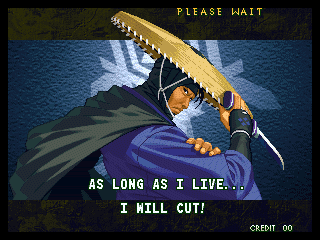
Filed under: Uncategorized | 1 Comment
Tags: Editing, The Last Blade
Deformed Cliches
A quick entry today….
And from the Stygian abyss of the past, dear reader, I bring an evangelical gospel of good news, nothing less than a divine commandment….
Receive this blog post as an omen!!!
Because today at SpecTechnique we’re looking at deforming cliches, and how to bend ‘em back into shapes that are fresh again.
Here’s what I mean:
This Jones was really starting to get under her lotioned skin.
– John Kennedy Toole, A Confederacy of Dunces
[Des Lupeaulx] was feeling the beat of what little heart he had when, on the staircase, he ran into his lawyer…
-Balzac, Les Employes / The Bureaucrats
If you’re as smart as M. John Harrison you can use a cliche into the skeleton on which to hang a brilliant sentence:
Glued to its own feeble destiny in the leaden blue moonlight, the clique at the Bistro Californium regarded its own navel with surprised disgust.
-MJH, A Storm of Wings
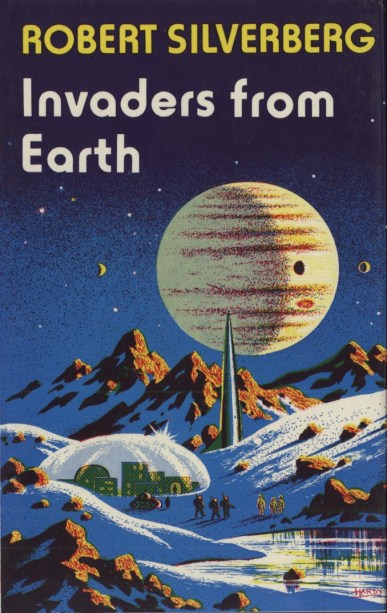
Another move is to add to the cliche or push past the cliche. Here’s a bit from the early Robert Silverberg novel, Invaders from Earth, when the POV character Kennedy is hit with a surprise.
Kennedy kept his face blank of emotional reaction. The “agency mask,” Marge called it privately.
Yawnworthy, right? We’ve all seen this exact same line used dozens of times. But Silverberg makes it new by one-upping it in the next sentence:
What Marge didn’t know was that frequently the agency mask hid an equal blankness of inner feeling.
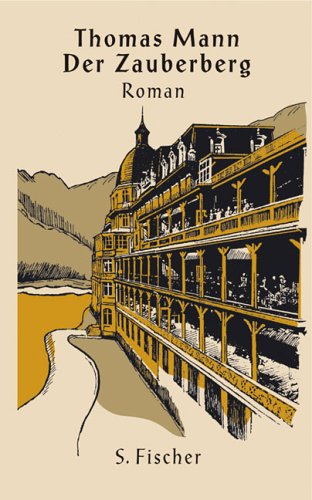
You can also do this with moments in sentences that aren’t exactly cliches, but still lead the reader into a conclusion. In Thomas Mann’s The Magic Mountain, POV character Hans Castorp is talking to his cousin Joachim about the young Marusya, another guest at the sanatorium:
“Her name’s Marusya, if you please — it’s about the same as our Marie. Yes, she really is too enthusiastic,” he said. “When she has every reason to be more sedate, because she’s more than a little ill.”
“You’d never know it,” Hans Castorp said. “She’s in such good shape. You’d never take her for someone with a weak chest.” And he tried to catch his cousin’s eye, but discovered that Joachim’s tanned face looked all blotchy, the way tanned faces do when the blood rushes out of them, and that he had wrenched his mouth into a peculiar, woeful expression that gave Hans Castorp a vague fright and caused him immediately to change the subject. He asked about certain other people and tried to forget both Marusya and Joachim’s expression—
Well? Do you think he can?
Come on! Can anybody in literature ever successfully forget an ominous hint? We practically know beforehand the end of the sentence is going to read “—but he couldn’t.” Right? So Mann writes:
—and was totally successful at it.
The strength of the deformed cliche is that it lures the reader into expecting the familiar, and blindsides him with the new.
Continuing that problematic metaphor, this is a sentence-by-sentence technique for making your prose punchier. (groan…)
Also, when editing your MS, it’s sometimes nice to take a break from erasing cliches and spend some time expanding them or flipping them around.
Filed under: WRITING STYLE | Closed
Tags: Balzac, Cliches, John Kennedy Toole, M John Harrison, Robert Silverberg, Thomas Mann
Linky Linky
Today in lieu of an update here I’m doing a guest post at Grasping For The Wind about “Misdirection in Worldbuilding.” Big up to John Ottinger for featuring me.
Tomorrow, check back here for a post on “Deformed Cliches.”
-NT
Filed under: LINKAGE | Closed
Tags: Clarion West, grasping for the wind, ray gun revival, vampires
Evacuated Descriptions
Hello SpecTechnique readers. Today I’ve got a short but hopefully interesting entry about what I like to call evacuated descriptions.
One of the most frequent notes I got when I started out writing was that my verbs were weak & wimpy. I preferred “was running” to “ran”; “was defeated” to “lost.” My verbs weren’t sufficiently active and dynamic. This is normal stuff, the advice beginners need to to hear, and it’s addressed well in this article. (Ignore the political ads!) Chances are if you take it to heart, it’ll make your writing clearer, snappier, and more fun to read.
I wouldn’t say my verbs are perfect now, but in my 5-6-odd years of writing practice I think I’ve improved a bit. I’m certainly more mindful about verb phrases now than I was before.
But what I figured out recently is that, just as you can pep up your prose by using stronger verbs, you can also create a flat feeling by doing the opposite.
Why would you ever want to do that?
Like if you need to create a sense of spareness and quiet to fit the atmosphere of the scene, as in Georges Simenon’s The Engagement:
The boulevards were emptier than usual. People were huddled in small groups around the braziers. The asphalt was white from the frost.
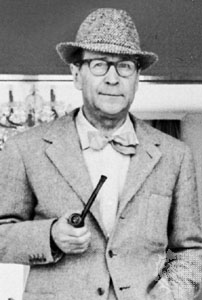
too cool for colorful verbs
Or if you want to create a distanced, dreamlike, exhausted feel, as in Michael Moorcock’s “Crossing into Cambodia” (I found this short story in the VanderMeers’ New Weird antho). I’ve bolded all the verb forms.
The jungle was behind us now and seemed to have been a screen hiding the devastation ahead. The landscape was virtually flat, as if it had been bombed clean of contours, with a few broken buildings, the occasional blackened tree, and ash drifted across the road, coming sometimes up to our horses’ knees. The ash was stirred by a light wind. We had witnessed scenes like it before, but never on such a scale. The almost colourless nature of the landscape was emphasised by the unrelieved brilliance of the blue sky overhead. The sun had become very hot.
Can you feel the mood Moorcock creates precisely by avoiding the usual writing advice you hear, to “make your verbs exciting”? (Note that “blackened” and “drifted,” which might look at first like active simple past verbs, are in fact used as past participles.)
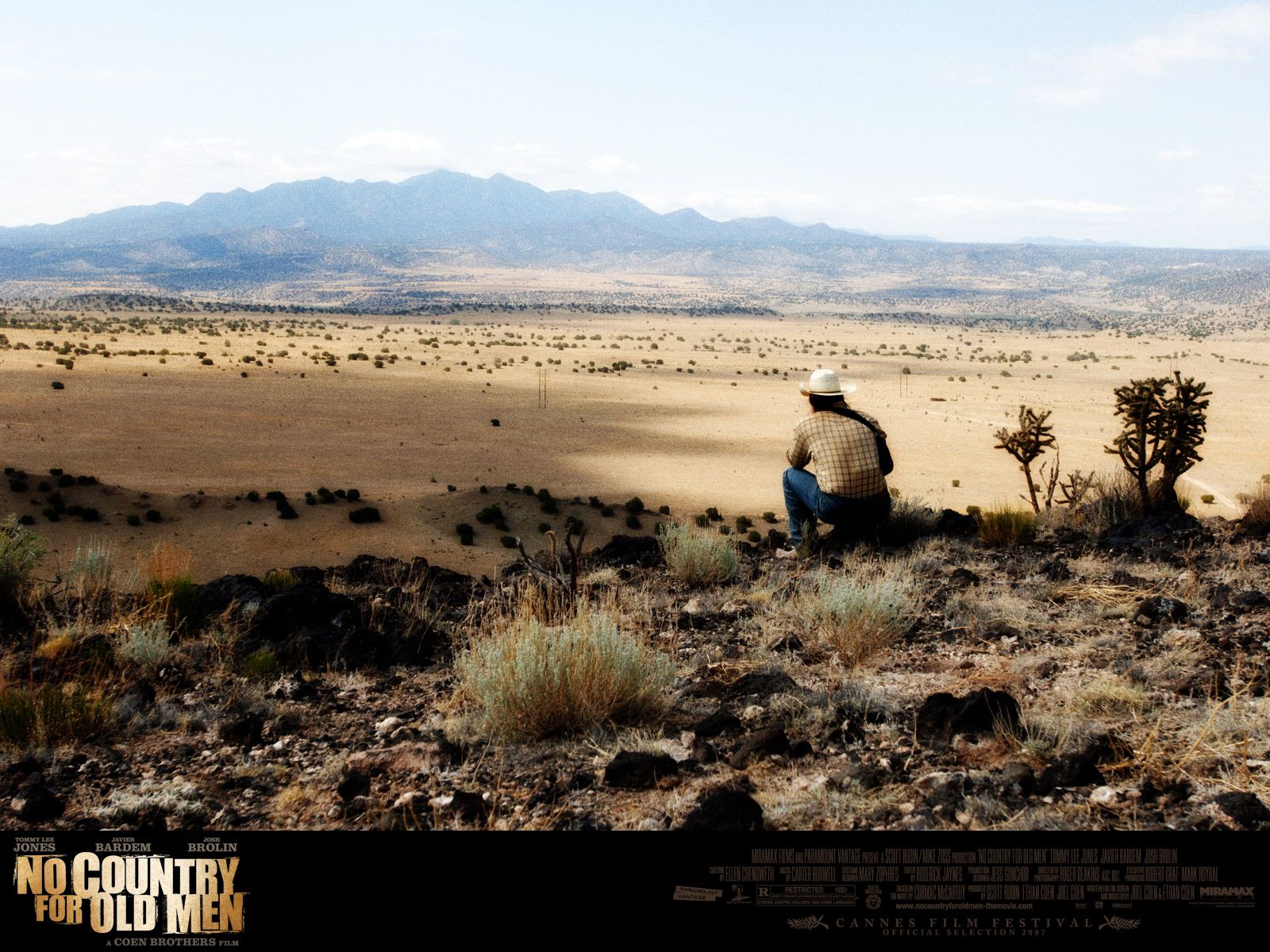
Finally, you can use this distancing technique if you want to create a sense of stillness and expansion. Here’s Cormac McCarthy in No Country for Old Men.
The raw rock mountains shadowed in the late sun and to the east the shimmering abscissa of the desert plains hung dark as soot all along the quadrant.
Because “shadowed” and “hung” can both be read either as verbs simple past verbs or as past participles, I can’t actually tell if this sentence has any verbs at all. All I know is, I like the feeling the ambiguity creates.
Check back Monday for some linkage…
Filed under: WRITING STYLE | Closed
Tags: Cormac McCarthy, Georges Simenon, Michael Moorcock
 SpecTechnique