The Agreement Turnaround
Today at SpecTechnique I’ve got a short article about a neat little dialogue trick I like to call the agreement turnaround.
One sure sign of limp dialogue in a story is when it follows a boring question-answer, question-answer, yes-that’s-very-interesting pattern. So to generate conflict and delight, I think it’s helpful to break up that flow whenever possible, using zingers, slams, rhetorical questions, non sequiturs, comebacks, euphemisms, and snide remarks of all types.
The agreement turnaround works as a conversational judo throw in which B appears to agree with an original statement made by A… except the meaning is caustic, rather than complimentary.
Here’s an example from Chapter II of Mary Gentle’s Rats and Gargoyles:
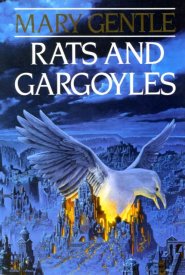
Something about her made him want to drop all pretense. “Actually,” Lucas said, “I’m the heir to the throne of Candover. Prince Lucas. Eldest son of King Odorno.”
She trod on the end of the satin stole, and swore.
“Incognito?”
“That was my idea.” He pushed his fingers through his thick springy hair. “I thought it would be good. To not be a king’s son. I suppose I thought people would treat me the same; that it would show through, naturally, somehow — what I really am.”
The White Crow said drily, “Perhaps it does,” and straightened up with a much-thumbed pack of cards.
As usual, I ripped off my next example from M. John Harrison, who was commenting in Kathryn Cramer’s archived New Weird discussion thread. (A thread well worth reading, all 80,000 words of it.) This example isn’t from fiction, it’s about fiction, but the effect is still delightful
As Steph Swainston said above, the New Weird has high levels of particularity, colour, specificity, a real sense of a world. Part of the trick of doing that is to know when an idea is foregroundable or should stay as background. The cruellest thing I ever heard said about an f/sf writer came in response to a boast he made that he had twenty or thirty new ideas in a morning. Someone said quietly from the back of the room, “Yes, & the problem is you develop all of them.” You need to know how to keep detail distinct, & your background in the background, even–in fact especially–in widescreen. Part of the carpetbagging syndrome is the mining by a second generation of the background ideas & characters of great imaginers.
The agreement turnaround can also be an indirect way to show that the meek listener B is socially pressured into agreeing with windbag A’s inflated bloviations. Here’s an instance from Dostoevesky’s Demons:
The fogginess increased for poor, trapped Sofya Matveevna when the story turned almost into a whole dissertation on the subject of how no one had ever been able to understand Stepan Trofimovich and of how “talents perish in our Russia.” It was “all so very intelligent,” she later reported dejectedly.
This summarized dialogue has got more pep than many a flat, expository conversation I could name.
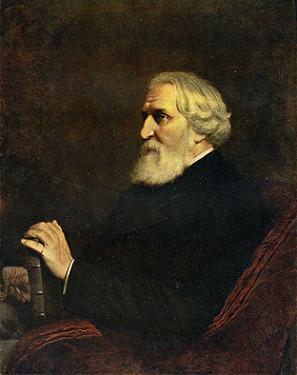
Turgenev, supposedly the model for Stepan T.
Another variant allows the shrewd A to set a trap for B by setting up a statement he’ll feel forced to agree with. This instance also comes from Dostoevsky, but from The Gambler. (For both these Dostoevsky quotes I’ve used the Pevear/Volokhonsky translations, because I don’t know enough about Russian to decide if another translation is superior.)
A: (indicates a group of people in the distance) “…You’ve noticed them, of course?”
B: “Oh, yes.”
A: “They’re not worth noticing…”
But my all-time favorite example of the agreement turnaround was a famous quip from Sidney Morgenbesser, a Philosophy professor at Columbia. Quoting his 2004 obituary from the Independent:
Generations of philosophers and linguists have heard the story of the Columbia lecture in the 1950s in which the eminent Oxford philosopher J.L. Austin explained how many languages employ the double negative to denote a positive (“he is not unlike his sister”), but that no language employs a double positive to make a negative. Morgenbesser, sitting in the audience, waved his arm dismissively, and retorted: “Yeah, yeah.”
Next time at SpecTechnique, our topic is “evacuated description.”
If you want to find out what I mean by this, you’ll have to return tomorrow. :-3
Filed under: DIALOG | 1 Comment
Tags: dostoevsky, kathryn cramer, M John Harrison, Mary Gentle, new weird, sidney morgenbesser
One part of creating a secondary world is working out a culture for that world: its songs, stories, plot devices and cliches; its holy books and its vocabulary of affect; how it represents and celebrates and criticizes itself.
One method of doing this is to build primary sources into your secondary world.
I’m talking about everything from “the scroll of the prophecy” to the works of philosophers & scientists that characters can cite or idolize. Think about all the times on Star Trek when somebody brought up Zefram Cochrane, or think of Paul Atreides quoting the Orange Catholic Bible.
But this method alone isn’t always enough.
Because if you’re building a world with anything like a modern feel, you have to attend to how print culture and information technology mediate people’s relation to culture, distancing them from primary sources and encouraging the use of secondary sources that refer back to the originals.
Or to put it less like a grad student: I’m talking about moments like when you saw a famous movie scene parodied on The Simpsons, before you had seen the original movie.
Think up ways that your characters might’ve learned their own culture without reading the primary sources.
Think up secondary sources for your secondary world.
My first quote isn’t a secondary-world example, but it’s a perfect statement of how print culture affects people’s relations to systems of knowledge. It comes from George Gissing’s New Grub Street, published 1891.
When she found herself alone and independent, her mind acted like a spring when pressure is removed. After a few weeks of desoeuvrement she obeyed the impulse to occupy herself with a kind of reading alien to Reardon’s sympathies. The solid periodicals attracted her, and especially those articles which dealt with themes of social science. Anything that savoured of newness and boldness in philosophic thought had a charm for her palate. She read a good deal of that kind of literature which may be defined as specialism popularised; writing which addresses itself to educated, but not strictly studious, persons, and which forms the reservoir of conversation for society above the sphere of turf and west-endism. Thus, for instance, though she could not undertake the volumes of Herbert Spencer, she was intelligently acquainted with the tenor of their contents; and though she had never opened one of Darwin’s books, her knowledge of his main theories and illustrations was respectable. She was becoming a typical woman of the new time, the woman who has developed concurrently with journalistic enterprise.
See how a reference to secondary sources can cause your characters to get a more atomized, general, less “authentic”, far more modern take on the culture they live in?
What people read structures how they think, how they build categories, how they refer to themselves… Think, for instance, of the queer character in John Dos Passos’ Manhattan Transfer who observes that the word for what he is “isn’t even in the dictionary.”
If you’ve decided to use today’s technique, one thing to consider is the contending claims of secondary sources: how they can misrepresent the eras they attempt to study.
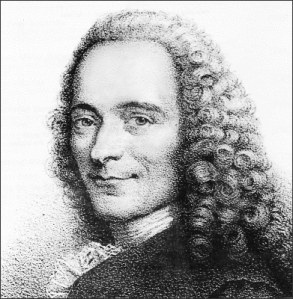
Voltaire, in his Philosophical Dictionary, takes classicists to task for creating secondary sources that confuse the issues:
[The ancients] had vague, uncertain, contradictory notions about everything relating to natural philosophy. Huge volumes have been written to determine what they thought about all sorts of problems of this kind. Four words would have sufficed: they did not think.
I for one would love to read some secondary worlds where scholarship is partial, biased, and even self-deluded — as opposed to how it’s usually portrayed, which is 100% effective at reconstructing the past. Think of Gandalf’s research project in Minas Tirith to determine the provenance of the Ring. Sure, it took him 70 years, but was Gandalf wrong about anything in the end? (Right now there’s no Tvtropes entry for the ridiculously chancy research project that winds up being right about everything, is there?)
A final variant on the “secondary source” is to ironically deflate a concept by presenting it as already SFnal from the point of view of the characters, like this exchange from my 9th grade obsession, the Ghost in the Shell manga:
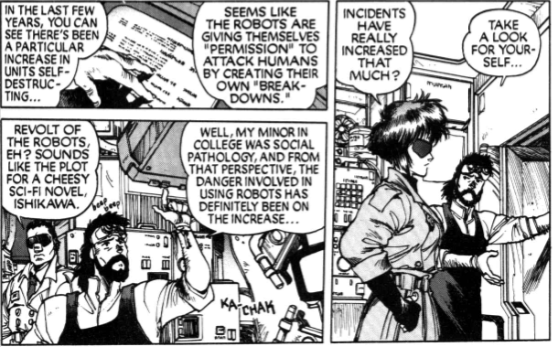
You can use this move in a lot of different ways, from lampshade-hanging to chilling, like this instance from Roadside Picnic:
Suddenly he had a horrible thought: it was an invasion. Not a roadside picnic, not a prelude to contact. It was an invasion. They can’t change us, so they get into the bodies of our children and change them in their own image.
He felt a chill, but then he remembered that he had read something like that in a paperback with a lurid cover, and he felt better. You can imagine anything at all. And real life is never what you imagine.
Check back tomorrow for a light but hopefully still interesting entry, SpecTechnique readers…
Filed under: WORLDBUILDING | 1 Comment
Tags: george gissing, ghost in the shell, roadside picnic, strugatsky, tolkien, voltaire, worldbuilding
What if every speculative invention & gimmick you wrote, also came packaged with a reasonable explanation as to why it was possible?
If you’re a hard science fiction writer, this probably sounds like an immense blessing. Say goodbye to worrying how you can make the physics work out. It’s now easy to think up second-order effects; they also flow naturally out of this conceit we’re taking. From now on, say goodbye to searching for ways to make things seem credible to the Reality Police. That’s all covered, and like a picnic basket stuffed with goodies that appears in your kitchen, you’ve got no shortage of concepts and extrapolations to build from. Everything you write automatically locks into place, forming an elegant system based on just a few deviations or extrapolations from the real world. Your O’Neill colony, cyberpunk dystopia, or generation ship will accrete effortlessly from a combination of cool ideas, each setting up the next…
But if you’re a weird writer, this situation might sound more like a curse!
If you don’t believe me, imagine what Poe’s “The Tell-Tale Heart” would be like if it also included an explanation that the heart was audibly beating under the floorboards because the dead old man had previously eaten a rare species of mushroom that just happens to cause heart palpitations in corpses on an audio wavelength only audible to people of a certain age, thus explaining why the narrator hears it and the policemen don’t.
WHY DID U OVEREXPLAIN
Or imagine how enjoyable “The Metamorphosis” would become if it included a plotline about Gregor Samsa figuring out that he was transformed into an insect-like vermin because he was accidentally injected with tainted DNA by an insane Professor from the Imperial Evil University of Prague, who had just happened to pass Gregor on the street yesterday and took exception to his shabby jacket.
kakfa was surprisingly a hottie
You see the problem?
Okay, I’ll admit it. It’s true that I didn’t try very hard to come up with these explanations.
But don’t think for an instant that if my explanations were of a higher quality, the tales would be improved.
When I’m reading Kafka or Poe, I usually don’t even want to know why the weird events are occurring. I’m far more interested in the emotional situation at hand — and in the affect that this instance of the weird produces in me — than I’m interested in some BS explanation which in twenty years will likely be disproven. In many weird tales, mechanics and rules are no longer the point.
Because no possible explanation could ever measure up to the immense, weird, psychological, fraught, bizarre explanations that the reader herself will naturally project onto the tale in lieu of an authorial explanation.
TL;DR, if you’re writing this kind of weird story — or, for that matter, if you’re writing soft SF where the tech isn’t the point — you may find it helpful to use today’s literary device, which I call “explaining without really explaining.”
It’s a device you can use when your sentence rhythm or story structure seems to call for something that feels like an explanation, but you’d rather avoid committing to one. Here’s a good one from David Lindsay’s A Voyage to Arcturus.
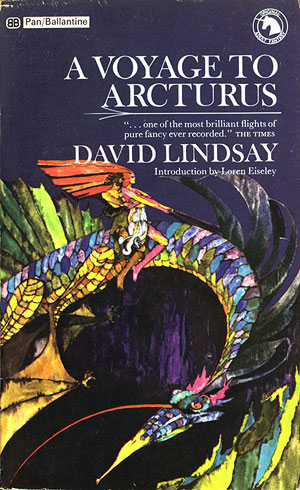
chromasnake drifter
Maskull then obtained his first near view of the mysterious light, which, by counteracting the forces of Nature, acted indirectly not only as elevator but as motive force.
Note now the phrase “by counteracting the forces of Nature” feels like an explanation, but in fact is only a restatement of the wonder being described. The rules of the gimmick are clear, the explanation is not.
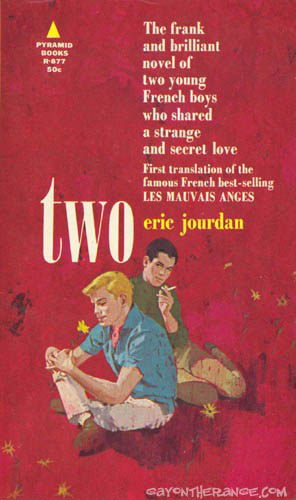
It’s possible to ‘explain without really explaining’ in the psychological sphere too. Check out how Eric Jourdan used it in the gay classic Les mauvais anges [Wicked Angels]:
❤
We were alone, almost as if we were living alone together, two boys without any feminine complications between us. It was possible, not so much because of the weakness borne of dark feelings, but from a virile attachment forged of camaraderie and love.
Let’s try to parse this: we were two boys with no feminine complications. Why? Because we had a virile [read: masculine] attachment. In other words, we were A because we were not B. As for why we weren’t B, well, let’s not go there…
In terms of logic, this beautiful sleight-of-hand is not so far away from Monsieur Purgon, the doctor in Moliere’s “The Imaginary Invalid” who chalks up his patient’s maladies “to your bad constitution, to the imtemperament of your intestines, to the corruption of your blood, to the acrimony of your bile, and to the feculence of your humours.” ….. But Eric Jourdan makes it work for the most part, though he can sometimes stray into a kind of literary autopilot where he overuses it.
Sometimes, the feeling of an explanation is sometimes all you need to represent how we think. Lately I was reading an Ann Beattie story called “The Big Outside World” [collected in Where You’ll Find Me] where I noticed this line:
The clothes were pretty, and when he began tossing them and draping them around his body she blinked at the flashes of color and could remember places she had worn them, whole days and nights that seemed to be explained by what she had worn.
Cool line, right? Yet if Beattie had gone to the point of spelling out that explanation, she might’ve broken the psychological credibility of this moment.
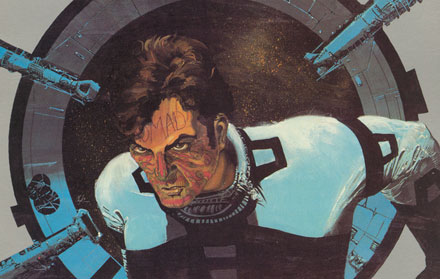
Moving from character analysis back to exposition, one delightful variant on this device is to present an obviously faulty explanation of the gimmick in question. Alfred Bester’s classic The Stars My Destination takes place in a world where everyone can ‘jaunte’, or teleport at will. But Bester doesn’t exactly fall over himself to provide good reasons why. In fact, he delights in doing just the opposite…
gully foyle, what a character
How, exactly, did man teleport? One of the most unsatisfactory explanations was provided by Spencer Thompson, publicity representative of the Jaunte Schools, in a press interview.
THOMPSON: Jaunting is like seeing; it is a natural aptitude of almost every human organism, but it can only be developed by training and experience.
REPORTER: You mean we couldn’t see without practice?
THOMPSON: Obviously you’re either unmarried or have no children — preferably both.
(Laughter)
REPORTER: I don’t understand.
THOMPSON: Anyone who’s observed an infant learning to use its eyes, would.
REPORTER: But what is teleportation?
THOMPSON: The transportation of oneself from one locality to another by an effort of the mind alone.
REPORTER: You mean we can think ourselves from.. say… New York to Chicago?
THOMPSON: Precisely; provided one thing is clearly understood. In jaunting from New York to Chicago it is necessary for the person teleporting himself to know exactly where he is when he starts and where he’s going.
REPORTER: How’s that?
THOMPSON: If you were in a dark room and unaware of where you were, it would be impossible to jaunte anywhere with safety. And if you knew where you were but intended to jaunte to a place you had never seen, you would never arrive alive. One cannot jaunte from an unknown departure point to an unknown destination. Both must be known, memorized and visualized.
REPORTER: But if we know where we are and where we’re going…
THOMPSON: We can be pretty sure we’ll jaunte and arrive.
REPORTER: Would we arrive naked?
THOMPSON: If you started naked. (Laughter)
REPORTER: I mean, would our clothes teleport with us?
THOMPSON: When people teleport, they also teleport the clothes they wear and whatever they are strong enough to carry. I hate to disappoint you, but even ladies’ clothes would arrive with them.(Laughter)
REPORTER: But how do we do it?
THOMPSON: How do we think?
REPORTER: With our minds.
THOMPSON: And how does the mind think? What is the thinking process? Exactly how do we remember, imagine, deduce, create? Exactly how do the brain cells operate?
REPORTER: I don’t know. Nobody knows.
THOMPSON: And nobody knows exactly how we teleport either, but we know we can do it — just as we know that we can think. Have you ever heard of Descartes? He said: Cogito ergo sum. I think, therefore I am. We say: Cogito argo jaunteo. I think, therefore I jaunte.
If it is thought that Thompson’s explanation is exasperating, inspect this report of Sir John Kelvin to the Royal Society on the mechanism of jaunting:
We have established that the teleportative ability is associated with the Nissl bodies, or Tigroid Substance in nerve cells. The Tigroid Substance is easiest demonstrated by Nissl’s method using 3.75 g. of methylen blue and 1.75 g. of Venetian soap dissolved in 1,000 CC. of water.
Where the Tigroid Substance does not appear, jaunting is impossible. Teleportation is a Tigroid Function.
(Applause)
Notice how Bester’s wickedly fake explanation clearly conveys the rules of teleportation without actually addressing the science. And think about it, would you rather read this, or read a straight, labored explanation where quack science is taken to a nauseating level of detail?
The last thing I’ll say about “explaining without really explaining” is that while it might be okay in fiction, it should be called out when spotted in reality; it’s a sure sign that some asshat is trying to con the public. Check out this gem of logical argument from Reflections on the Revolutions in France [1790] — I spotted it the day I decided to buckle down and read Edmund Burke, which not coincidentally was the day I finally lost all sympathy for classic conservatism.
Emphasis of course is mine:
We know that the British House of Commons, without shutting its doors to any merit in any class, is, by the sure operation of adequate causes, filled with everything illustrious in rank, in descent, in hereditary and in acquired opulence, in cultivated talents, in military, civil, naval, and politic distinction that the country can afford.
See u next time #nerds, when the topic will be “Secondary Worlds, Secondary Sources.”
Filed under: CHARACTERIZATION, EXPOSITION | 8 Comments
Tags: a voyage to arcturus, alfred bester, ann beattie, david lindsay, edmund burke, eric jourdan, gay novels, kafka, moliere, poe
An observer might…
Happy Monday, dear SpecTechnique readers.
One of the reasons I enjoy reading 19th century novels (just like I enjoy reading old-school SF like E.E. “Doc” Smith & A.E. Van Vogt) is that I like seeing devices that have now fallen out of fashion.
Because after that, I can try out ways to make ‘em new again.
One classic lit move, now considered somewhat awkward, is to state the reaction that a hypothetical observer would have.
Here’s an example from my beloved example source, Balzac’s Splendeurs et misères des courtisanes.
About his costume, an observer might have said to himself: ‘There goes a squalid person, he drinks, he gambles, he has vices, but he doesn’t get drunk, he doesn’t cheat, he isn’t a thief or a murderer.’ And Contenson was indeed indefinable until the word ‘spy’ came into one’s mind.
Similarly, in Dostoevsky’s The Adolescent, illegitimate young Arkady Dolgoruky writes a narrative of his travails dealing with his extended family, and charmingly goes meta to declare a takeaway from his own writing:
If I had a reader and he had read all that I’ve already written about my adventures, doubtless there would be no point in explaining to him that I am decidedly not fit for any society whatever. Above all, I’m totally unable to behave myself in society.
(Be sure to check this book out; of all the Dostoevsky novels I’ve read it’s the most adorably flawed and maybe even therefore the most formally adolescent novel… 😀 )
A more timeless, less artificial option is for a character to imagine him/herself in a counterfactual category and speculate on his/her possible reactions from that position. Check out Charlotte Brontë in Villette, where shy Lucy Snowe thinks herself into someone else’s shoes. Note the characterization effect here; Lucy’s self-esteem is so low she can only permit herself to have an opinion through mental gymnastics:
Had I been a gentleman, I believe Madame would have found favor in my eyes.
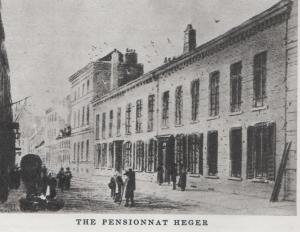
If u read Villette, try to get the Broadview edition. This press never lets me down when it comes to extensive footnotes & critical commentary.
Maybe it’s because it seems to be telling the reader how to interpret the text, this device has now fallen mostly out of style. But worry not, it’s still usable — I have the feeling the trick is to add a twist.
Here’s an example (in admittedly debatable taste) from Kikuchi Hideyuki’s Vampire Hunter D: Raiser of Gales:
If a telepath had been there, they might’ve caught a whisper of a grin deep in the recesses of his coldly shuttered but human consciousness.
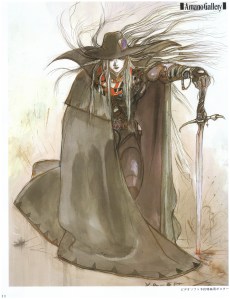
Still sort of awkward, right? Heh, I like the line, but then I’m a known sucker for telepathy & all that bullshit.
A more durable, even sneakier way to get away with this technique is to specifically declare that no observer is present… to make a certain observation… like this:
The rain has stopped, and the sky has cleared. The night is mute, and there is no traveler to see how the author’s attic hangs in the night, mounted on little nails of light emanating from the cracks and holes, like the sky on the stars. There seems to be a fire in there. Or one is just going out.
This beautiful night scene comes from the end Andrei Bitov’s brilliant time-travel short story “Pushkin’s Photograph.” Sadly, you might need to hie thee to a research library or buy used on Amazon to find The New Soviet Fiction: Sixteen Short Stories. (Big up to my sister for tipping me off to this cool tale.) But it’s probably only a matter of time before this one gets anthologized somewhere new.
Finally, M. John Harrison… whom I’m probably going to cite heavily on this blog, because his books are a masterclass in literary style… uses a nice first-person variant on this in “In Autotelia,” which you can find in the recent New Scientist-backed zine ARC 1.1.
The “municipal room” at the New Ministries. If you stood there with me this is what you would see: locals in an orderly line, not really a queue, facing expectantly into the room with their backs to the polished wood panelling. Facing them are looser groups of people from our side of things, dressed with a certain formality though they’re not sure how to behave in this situation. They seem uncomfortable, as if this is the first time they have been here, which for most of them, it is. Hopefully it will be the last.
Tomorrow on SpecTechnique: Explaining Without Really Explaining.
Filed under: EXPOSITION, VIEWPOINT, WRITING STYLE | Closed
Tags: Balzac, charlotte bronte, dostoevsky, M John Harrison, vampire hunter d
Unexpected Explanations
One of the most powerful ways to generate delight for your reader while writing SF/F, or maybe just writing period, is the device of the unexpected explanation.
To do this, begin with an expected, ordinary line, followed by an explanation rooted in your SFnal milieu.
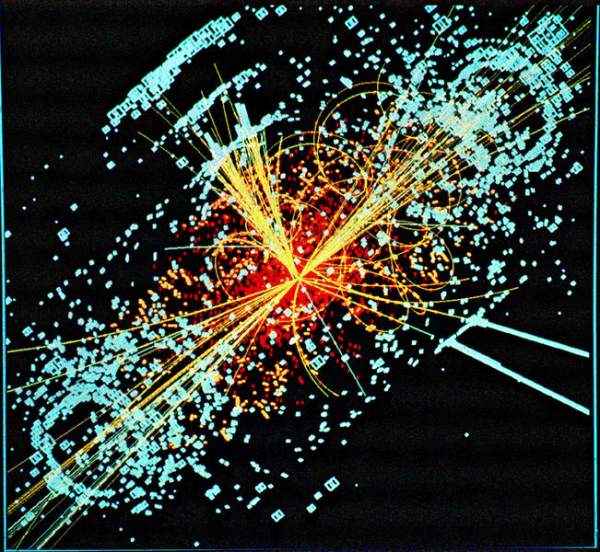
In M. John Harrison’s brilliant Nova Swing, a character enters a bathroom:
There was a smell of urine, but that was artificial.
Or look at this bit from The Space Merchants [Frederik Pohl & Cyril M Kornbluth] when the POV character looks at an object in the distance:
There probably wasn’t another sight like it in North America. It troubled my eyes. Not for years had I focused them more than a few yards.

Less SFnally, you can create jokes by creating unexpected explanations and glosses for ordinary terms. Check out Dostoevsky in The Idiot [Pevear & Volokhonsky, trans]:
Afasany Ivanovich never concealed that he was somewhat cowardly, or, more precisely, in the highest degree conservative.

The flip-side of this technique is to start out with a bizarre idea, and then follow it up with a surprisingly reasonable explanation.
As used by H.G. Wells in The Island of Dr. Moreau, this can be a device for selling the impossible:
A pig may be educated. The mental structure is even less determinate than the bodily. In our growing science of hypnotism we find the promise of a possibility of replacing old inherent instincts by new suggestions, grafted upon or replacing the inherited fixed ideas…
(Educating pigs, that’s nuts! the reader thinks. And then the unexpected analogy to the familiar:)
…Very much of what we call moral education is such an artificial modification and perversion of instinct; pugnacity is trained into courageous self-sacrifice, and suppressed sexuality into religious emotion.

Naturally, this technique isn’t always devoted to selling bizarre SF concepts. Tolstoy uses it for simple characterization in Anna Karenina, where Stiva chooses to dine at the Anglia hotel…
…because he owed more in the Anglia than in the Hermitage. He therefore considered it not nice to avoid that hotel.

(photo: Greta Garbo as Anna)
And this nifty technique is also a hallmark of Gu Long’s intense & snappy wuxia style. Here are some examples of unexpected explanations from Bordertown Wanderer…
The dirt and sand on the floor was burning hot, Fu HongXue bent down and scooped a handful into his hands. Snow could be burning hot as well — snow that was soaked in hot blood. He squeezed down hard as the particles of sand dug deep into his skin.
Only the words of the dead are always honest … because they no longer have any reason to lie to you.
“Besides, corpses often reveal many secrets. It’s just that the manner in which they convey their message is usually hidden.”
Finally, the unexpected explanation is a way to “grab the reader back” after an extravagant & extended metaphor, showing that we weren’t just fucking around, there was a point to what we were saying there.
(This insecurity lurks in the heart of every SF writer…)
In another scene from The Etched City, a character begins reflecting on the mythological figure of the Sphinx:

By speaking to its victims it appeared to seek relief from solitude – for solitary it had to be, having no equals – a trait which suggested that if the monster possessed the same self-knowledge that it offered as a prize for answering its riddles, such knowledge wasn’t enough to keep ennui away…
Gee, that’s kind cool, but…. so what? The reader might think. Fortunately, K.J. Bishop rolls in with a real-world reason to care:
…It could perhaps be considered the heraldic totem of the chattering classes.
LOL
Anybody else fond of unexpected explanations?
Monday’s post: “An Observer Might Think…”
Filed under: Uncategorized, WRITING STYLE | Closed
Tags: cyril m kornbluth, dostoevsky, frederik pohl, Gu Long, H.G. Wells, K J Bishop, M John Harrison, space merchants, Tolstoy
 SpecTechnique