Totalizing Claims
Are you worried that your secondary-world fantasy seems too modern, enlightened, and progressive?
Are your characters overly aware and critical of the ideology of their setting, creating a frame-breaking Mary Sue effect by which they act as mouthpieces for your contemporary opinions about race, class, and gender?
Do you sometimes struggle to write characters who, like all of us, are in some way compromised and limited by their social & political circumstances?
In short, do you want some good old-fashioned ideology in your fantasy world?
With the rise of the 20th century and modern progressive politics, it became unfashionable for literary novels to make totalizing claims about identity, society or ethics. Today, writers usually have a vague the sense that all points of view are legitimate — especially when it comes to personal identity — but that no single point-of-view has the right to make a claim to absolute truth. Thanks to literary critics, we’ve also got a decent shot at being aware of how often “the omniscient narrator” has been responsible for writing the experiences of women, people of color, the QUILTBAG crew, the proletariat, etc, out of literature.
It might even be said that today, the omniscient POV can only be written with a guilty conscience.
What I’m talking about is a way for progressive writers to prevent their historically grounded work from feeling too contemporary.
One of the fastest and most elegant techniques is to throw a few totalizing claims into your tale. This is a way of achieving a premodern feel economically. This way you convey an effect of a socially repressive & reactionary setting simply by suggesting a totalizing way of thinking about things.
Check out how it works.
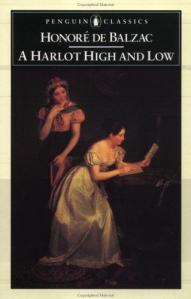
Check out these examples from Honoré de Balzac’s Splendeurs et misères des courtisanes, usually Englished as A Harlot High and Low. (Trans: Rayner Heppelstahl, Penguin Classics ed.)
“An artist’s physiognomy is always abnormal, always above or below the conventional lines of what fools call ideal beauty.”
“In Paris, extremes meet by way of the passions. Vice indissolubly welds the rich to the poor, the great to the small.”
“All passion in Paris is resolved into two terms: gold and pleasure.”
Don’t think for a second that these are the opinions of characters in Balzac’s Paris. These are the opinions of Balzac’s omniscient narrator himself. (Yes, it would be a he.) And, although they’re somewhat ridiculous, isn’t the philosophical sureness, the completely un-modern confidence with which these aphorisms are dealt out, kind of, well…
….refreshing?
This device also works in POV, where it serves above all to characterize the voice.
(I would even hazard an equation: the number of totalizing claims made by a narrator scales in relation to his/her level of cluelessness, since the most clueless characters are those who feel the most confident that they posess eternal truths.)
Let’s take a look at Poe’s use of this device in his wonderful short story “The Assignation.”

Here the totalizing claims take the form of a gaze; they tend to be more aesthetic than social, and contribute to the development (at least from our perspective) of a truly self-deluded POV character. Emphasis is mine:
‘There is one painting,’ said he, […] –‘there is still one painting which you have not seen.’ And throwing aside a drapery, he discovered a full-length portrait of the Marchesa Aphrodite.
Human art could have done no more in the delineation of her superhuman beauty. The same ethereal figure which stood before me the preceding night upon the steps of the Ducal Palace, stood before me once again. But in the expression of the countenance, which was beaming all over with smiles, there still lurked (incomprehensible anomaly!) that fitful stain of melancholy which will ever be found inseparable from the perfection of the beautiful.
If you want to find out just how self-deluded this narrator is, read the story. (Bonus points for spotting the shoutouts to Otway’s bromantic Restoration drama, Venice Preserv’d.)
Judiciously used, the well-timed totalizing claim can help the contemporary writer achieve an antique, unmodern feel. Riffing on Joris-Karl Huysmans and the Comte de Lautréamont, K.J. Bishop put this technique to good use in The Etched City.

At an elegant salon, a character has just died randomly; here Marcon, a brooding walk-on character, reacts:
“Time is the only predator not ultimately on the side of life, don’t you think?” said Marcon, in a serious and cold voice.
Similarly, check out Severian’s crypto-Catholic reflections throughout Gene Wolfe’s Book of the New Sun. (detail from Japanese cover art by Yoshitaka Amano)

My favorite comes at the end of The Claw of the Conciliator:
In the final reckoning there is only love, only that divinity. That we are capable only of being what we are remains our unforgivable sin.
If you want to create a premodern feel in your fantasy, try this technique yourself!
And be sure to check back with SpecTechnique tomorrow, when we cover “Unexpected Explanations.”
Filed under: WRITING STYLE | 1 Comment
Tags: Balzac, gene wolfe, K J Bishop, poe
Beginnings: The Promise
Welcome to SpecTechnique, a technical blog for speculative fiction writers. Every day, I’ll be presenting a different technique of interest, we’ll cover everything from action to aphorism.
Today we’re going to look at intro paragraphs.
The intro paragraph is probably the most important paragraph in a short story. That paragraph may be all that busy editors and seen-it-all slush teams actually read before tossing your manuscript to the side.
The upside to this is that — for at least that beginning paragraph — your story’s readers are yours to lose.
Unless you’re trying a particular technique, I think it makes sense for your first paragraph to subtly showcase the following:
- the premise of your story (or part of it), and therefore its genre
- the main character, their voice (if the story’s first-person), a reason to care about them
- the general style the story will be written in (florid, terse, humorous, etc)
- what mood & emotional terrain your story will cover (love story vs revenge story, wedding story vs bereavement story, comedy vs tragedy)
- an indication of the setting, if possible.
- Finally, and maybe most important, a sense of what kind of delights your reader can expect to get by reading on.
We could easily go on, but even just this much sounds like a lot to do in just one paragraph, right? Oh god, a checklist? But in fact, this checklist isn’t hard to do:
Few murder streets are lovely. This one was.
Although this paragraph is only 8 words long, once you read it, you can’t help but reach quite a few conclusions:
- the story is probably a murder mystery
- the main character has visited more than one “murder street” and hence probably has experience fighting crime
- the style of this story will be snappy and straightforward
- the mood of the story will be serious
- the setting is a murder scene on a street, and what’s more, a lovely one
- if I keep reading, I can expect to find out whodunit, why, how, etc.
(In fact, this is the paragraph of Jonathan Kellerman’s novel The Clinic, which I saw cited in the excellent Don’t Murder Your Mystery.)
Now let’s look at another, longer intro paragraph — that of James Morrow’s “Bigfoot and the Bodhisattva,” which you can find in Conjunctions: 52.
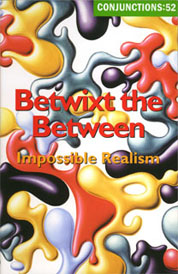
Here we go.
After thirty years spent eating the chilled coral brains of overachieving amateur climbers who believed they could reach the summit of Mount Everest without dying, a diet from which I derived many insights into the virtues and limitations of Western thought, I decided that my life could use a touch more spirituality, and so I resolved to study Tibetan Buddhism under the tutelage of His Holiness Chögi Gyatso, the fifteenth Dalai Lama.
This paragraph is a masterclass in setting up the promise of a good specfic yarn through summary.
- The premise of the story is that a yeti who absorbs thoughts by eating the brains of dead mountain climbers has decided to go study with the Dalai Lama.
- POV character: a yeti undergoing a spiritual crisis
- Style: long clauses indicate a slightly academic style, unusual for a yeti to say the least, yet potentially understandable given the premise of absorbing thoughts by eating the brains of (probably American) mountain-climbers. (In the second paragraph, this hypothesis will be confirmed.)
- Mood: comic, but straight-faced
- Setting: Himalayas
- Why to keep reading: this intro paragraph is promising me a humorous story about Buddhism and eastern vs western thought, from the point of view of a westernized brain-eating yeti…… do I really have to spell it out much more?
Finally, let’s take a look at the intro to a newly published story — “God of the Gaps” by Carole Johnstone, which you can read in Interzone #238.
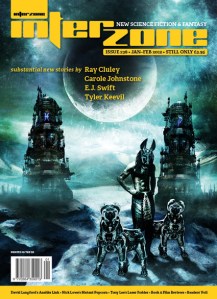
Here it is…
I’m expecting it — well, I’m expecting something — so when it actually comes I should be more prepared than I am. Instead, I almost scream out a lung and fling myself forwards, nearly knocking myself out against the lift’s closed doors. Brian is shrieking too, but this concern comes far down a lengthening list that ends with the possible concussion and began with the back wall of the lift being blown apart. There is much confused jostling — there were five of us in here a few seconds ago — and copious amounts of green smoke. I can’t see very much (which, I’m guessing, is probably the point), but what I can see looks very much like a giant xenomorph: all crude spines and hissing teeth, rattling briefly around our tiny space before yanking up a screaming body and disappearing backwards into nothing.
This is a much more complex intro paragraph than the previous two. Johnstone’s story begins in scene, with no context for what’s happening. However, the reason I like this intro so much is how it subtly lets us know that something in addition to the action is happening here. Here’s why:
- The narrator (gender is unclear so far) is in elevator with four others, expecting an attack to happen, only when it does, she’s not as prepared as she’d like to be. Question: why does she have advanced knowledge of the attack? What does she know? Monster attacks, as we all know, are supposed to be a surprise to everyone.
- There’s a clash between the rather leisurely language and the drastic events happening in the lift. The narrator’s “list of concerns” is a strangely involved and complicated phrase for a moment one might otherwise expect to depict visceral panic.
- What’s more, the narrator’s reflection that the smoke preventing her from seeing too much is “probably the point” indicates that there’s another layer to what’s happening here. Whose point? (Even before the monster appears, we’ve been given three clues that this is not an ordinary monster attack, but some other experience entirely.)
- The biggest giveaway that something is amiss here is the jargon. The narrator says the monster resembles “a giant xenomorph: all crude spines and hissing teeth.” In a straight SF story, the use of xenomorph sets off alarm bells, you can do Alien references in spec but they can’t be that direct unless this is a parody.
- Instead of an evocative or pictorial description, the narrator gives us the rather limp and generalized “all crude spines and hissing teeth. The narrator has seen all this shit before and isn’t impressed.
- With all these clues, we can be pretty sure of concluding that the monster attacking the party in the elevator is not a newly invented monster, but rather a prop — a creature out of the old SFnal playbook. And furthermore that, although the experience may be frightening, no one is truly in danger here.
By showing the reader that things aren’t as they seem, Johnstone keeps up the tension and generates interest long enough to draw them to the truth… which is that, in fact, the story is set in a theme park where monster attacks are staged for willing consumers who go specifically to be frightened. Of course, it soon turns out that things aren’t quite as they seem in this theme park… and that a few real monsters may actually be lurking in the dark, or maybe even out in the open.
If you want to find out what happens next, you’ll have to read Interzone #238 suckas! 😀
And if you do, pay attention to the first sentence in this story, and think about how it summarizes the eventual twist without giving anything away, just as Shelia Williams recommends here.
That’s it for our first day at Spectechnique. New updates rolling in every day like waves in the ocean as we talk about story mechanics again and again. See u tomorrow…
Filed under: BEGINNINGS | 4 Comments
Tags: carole johnstone, james morrow, jonathan kellerman
Coming Soon

This blog will go up pretty soon, follow me on twitter for the latest info.
Filed under: ABOUT, BEGINNINGS | 2 Comments
 SpecTechnique