Clarion West Class of 2012
I hear from the wonderful Neile Graham that acceptances have gone out to the Clarion West Class of 2012.

This year’s instructor lineup looks amazing: Mary Rosenblum, Hiromi Goto, George R.R. Martin, Connie Willis, Kelly Link and Gavin Grant, and Chuck Palahniuk.
This time last year, when I received my Class of 2011 acceptance, my heart was split between maniacal glee and total apprehension. And I’m sure everyone in this year’s crew is feeling the same way.
So if any of them happen to wander onto this humble blog, (or for that matter, any of the Clarion UCSD crew, to whom I also extend my greetz) I’ve got just 3 tips for them…
1. Start getting your Real Life in order, so that you can leave it for 6 weeks in the summertime.
2. Read books by your instructors. Don’t just look at their novels, either; since CW is focused on short fiction, try to read their short stories too. Try to get a feeling for the specific craft questions you want to ask each instructor. (However, there’s no need to go overboard, and if you don’t have time to do this, don’t stress out about it.)
3. If you have a certain Story I Know I Have To Write at Clarion West, and it requires research beforehand, get some of that out of the way. You’ll have plenty of time to write at CW, but probably not enough time to write and do research, especially if you like to write historical fiction or hard SF. By preparing your material, you’ll be in a good position to actually execute the story when you get to Seattle.
For instance, I went into CW knowing I wanted to write a story about using the Greek Magical Papyri to contact Confederate ghosts who inhabit a specific place in Chicago. So I spent some time beforehand researching.
However, don’t actually write the story beforehand!!! Even in the first week of the workshop your ‘game’ will improve so much that pre-workshop material won’t really represent your current abilities.
Welcome to the CW family, guys. You’re going to have an amazing summer.
Sure, writing 5-6 short stories in 6 weeks will be a bit stressful too… but, to quote Brotips,

Also, for anyone who didn’t get in this year, or wants to attend a Clarion or a Clarion-style program sometime in the future, here are some things you can do in the meantime:
1. Keep writing what you want to write, and keep reading a wide variety of material
2. Join an online critique group like critters.org
3. Don’t forget to apply next year!
Filed under: FUN | 2 Comments
Tags: Clarion West
GoneReading
I wanted to spread the word about a new philanthropic startup, GoneReading.

I’m not sure about the phrase “reading lifestyle” 😀 but the idea is that you buy their literary swag, and they donate the profits.
From their FAQ:
To fulfill our philanthropic mission, Gone Reading International donates 100% of its after-tax profit to fund new reading libraries and and other literacy programs around the world. This means that each year we donate a sum equal to or greater than our total revenues minus our total expenses, including any taxes paid. We donate these profits to non-profit organizations with proven models and long-term track records of success in building village libraries in the developing world.
Skeptical old me immediately wondered…
Right, but maybe you’re a top-heavy organization that wastes all of its “profit” on overhead and salaries?
Nothing could be further from the truth! In fact, our staff is 100% voluntary without any compensation to date. Owners Brad & Eileen Wirz have received no compensation from Gone Reading International.
This seems pretty legit and it’s for a good cause, so check out their store.
Happy weekend!
Filed under: FUN | Closed
Tags: gonereading, nonprofit
My “Humanity” Hobbyhorse
Most of my posts on SpecTechnique have been about stuff you can do in fiction & language. But today I’m going to talk, for a chance, about something to avoid.
And after you read this post, I hope you’ll avoid it too. Or at least think about it!
In high school, I was asked to read Jane Eyre for English class.
I thought the book was okay. Probably too long — depriving me of time I’d otherwise have spent playing Suikoden or Vandal-Hearts or Xenogears….

AP English alternative: PS1 role-playing games
— but still, Jane Eyre was pretty good all the same. Since unlike many others in the class I’d read the novel instead of the Cliff’s Notes, I felt prepared for the class discussion. Except that the discussion topic was this:
What makes Jane such a human character?
My thought was this:
If she’s not human, then what the fuck is she, a xenomorph?!!
Ever since that day, I’ve disliked the word human when it’s used to mean somebody who is empathic, kind, considerate, understanding, etc. Something about it just bugged me. But I didn’t really know what — until about a year later.
It was 2003, the time of the Iraq invasion. We were debating whether the invasion was a good idea or not. Today, it’s funny — funny in the sense of irony, otherwise horrible — to remember some of the claims and arguments that were thrown around in that classroom.
The most memorable argument of all came from one student who supported not only bombing Iraq and Afghanistan, but conducting total, genodical war on all Muslim nations.
“How could you actually support that?” we asked him.
“Because those people aren’t human anymore,” he replied. He’d seen footage of Palestinians cheering after September 11: “To see what happened on 9/11 and cheer, those people aren’t worthy to be called human beings anymore.”
I probably shouldn’t have to add that this guy thought of himself as a Christian.
(On another occasion, I called this guy out for some racist remark he made about African countries; enraged, he left the classroom… Later that day, my International Relations teacher took me aside and told me that actually, he couldn’t really be a racist — because he was friends with the black kid on the lacrosse team…)

secret xenomorphs
In any case, what that incident made me realize was that when ‘human’ is used as shorthand for “kind, considerate, person,” it also has the silent rhetorical effect of excluding foreign, unfamiliar, taciturn, bitter, silent, unsympathetic, non-neurotypical, othered, or just plain different people from the category of “humanity” whenever they don’t provide the response you think they ought to.
Ironically, “human” as a compliment actually dehumanizes people who don’t fit your particular standards.
And more than likely, those standards are the kind of thing you can’t precisely articulate, but rather, “you know it when you see it…”
This might as well be the fucking definition of ideology.
When you believe people have to meet your standards to qualify as human, you’re walking a wicked path, like Kefka!

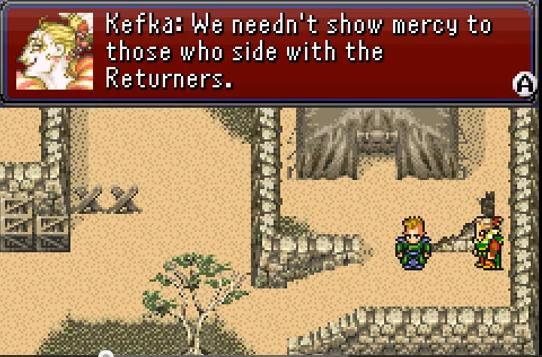
I don’t consider myself qualified to include and exclude people from the category of ‘humanity.’ That’s why when I write, I never use the word ‘human’ to mean ‘kind’.
And I hope you won’t either.
Therefore (here comes the spec fic) I was so delighted to see Ursula K. Le Guin flip the script on this in her short story “Coming of Age in Karhide,” which you can find in The Best of the Best antho. Here, two youngsters are talking about the changes happening in their bodies:
Sether burst out, “I’ll tell you what I hate, what I really hate about it — it’s dehumanising. To get jerked around like that by your own body, to lose control, I can’t stand the idea. Of being a sex machine. And everybody just turns into something to have sex with. You know that people in kemmer go crazy and die if there isn’t anybody else in kemmer?…”
These characters, inhabitants of planet Gethen, are human-like androgynes who only have a gender for 1/3 of the year, and I don’t remember if they can interbreed w/ Earth people… yet I think this word “dehumanizing” is perfectly chosen.
“But they’re actually not humans…” I can hear someone whining.
Nevertheless, Le Guin extends the concept of “humanity” to include them. And I think she’s right to do so.

❤
(Compare this to the utterly stupid moment at the end of Star Trek II when Kirk calls the dead Spock the most “human” person he ever knew. Spock would’ve regarded this as an insult. The key difference is that Spock would never describe himself as human, but Le Guin’s Gethenians do.)
You’d think this move would only be done by socially progressive writers. But weirdly, it happens in At the Mountains of Madness, by H. P. Lovecraft, who is like the platonic archetype of the racist, sexist, reactionary specfic writer. Nevertheless, here his human narrator feels human kinship with beings that are literally alien. Take a look at the extraordinary last line:
Poor devils! After all, they were not evil things of their kind. They were the men of another age and another order of being. Nature had played a hellish jest on them – as it will on any others that human madness, callousness, or cruelty may hereafter dig up in that hideously dead or sleeping polar waste – and this was their tragic homecoming. They had not been even savages-for what indeed had they done? That awful awakening in the cold of an unknown epoch – perhaps an attack by the furry, frantically barking quadrupeds, and a dazed defense against them and the equally frantic white simians with the queer wrappings and paraphernalia … poor Lake, poor Gedney… and poor Old Ones! Scientists to the last – what had they done that we would not have done in their place? God, what intelligence and persistence! What a facing of the incredible, just as those carven kinsmen and forbears had faced things only a little less incredible! Radiates, vegetables, monstrosities, star spawn – whatever they had been, they were men!
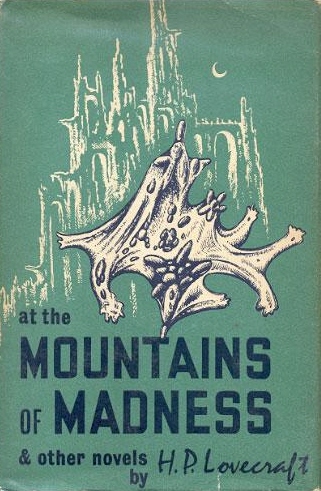
Even Lovecraft can surprise you, I guess.
Join me next time at SpecTechnique for “Archetypes vs Characters.”
Filed under: ANALYSIS | 2 Comments
Tags: humanity, lovecraft, ursula k le guin

I recently read Dan Brown’s The Da Vinci Code for the lols and I thought I’d share some of its worst passages with you.
Sophie looked equally intimidated as her eyes scanned the lobby.
Does her face have 2 personalities?
Pulling his driver’s cap down further, he effected as rough a facade as his cultured upbringing would allow.
Apparently that refined upbringing didn’t include the difference between effected and affected
The estate fondly had become known as la Petite Versailles.
what is that adverb position
The air inside smelled antediluvian, regal somehow, with traces of pipe tobacco, tea leaves, cooking sherry, and the earthen aroma of stone architecture.
Antediluvean??? Damn, this guy’s house is old!
The fond memory caused Sophie a pang of sadness as the harsh reality of the murder gripped her again.
Dan Brown finds a way to use 3 cliches in one sentence
“The Latin word haereticus means ‘choice.'”
Almost inconceivably, the gun into which she was now staring was clutched in the pale hand of an enormous albino with long white hair.
“Almost inconceivably”???
The Priory, like many European secret societies at odds with the Church, had considered English the only European pure language for centuries. Unlike French, Spanish, and Italian, which were rooted in Latin — the language of the Vatican — English was linguistically removed from Rome’s propaganda machine, and therefore became a sacred, secret tongue for those brotherhoods educated enough to learn it.
BECAUSE ENGLISH DOESN’T INCLUDE LITERALLY 10000 FRENCH LOANWORDS AND GERMANIC/FINNO-UGRIC/CELTIC/ANY OTHER EUROPEAN LANGUAGES DON’T EXIST
Also note the “Dan Brown italics” for delivering facts everyone already knows.
Remy could no longer see, but he could sense his oxygen-deprived brain straining to cling to his last faint shreds of lucidity.
Bahahahaha
Everyone in the reception area gaped in wonderment at the half-naked albino offering forth a bleeding clergyman.
What is this I don’t even
Although its plot twists are interesting & it’s got 3 or 4 good gimmicks, I still wouldn’t recommend reading this piece of shit.
I prefer my anti-Catholic propaganda in 32-bit form, after all…
Filed under: FUN | 3 Comments
Tags: da vinci code, dan brown

The rules of timekeeping are supposed to be simple in fiction.
Choose a tense when you start writing, and stick to that tense throughout — whether it’s past, present, or (god help us) future.
Sometimes, though, cutting to the present tense in your past tense story can create some unusual & noteworthy effects.Today at SpecTechnique we’re going to look at just a few of them.
The classic example is the so-called ‘historical present,’ which we use in speech every day.
Watch how naturally the shift occurs (I’ve bolded all verbs:)
It all started when I went to the racetrack last Sunday. The big race had just begun, and I’m standing there cheering and shouting, see — and all of a sudden this forty-something woman with a big blue wig who looks like she means business walks up to me and hands me an envelope.
And inside the envelope is a sheet of paper with just one word, RUN.
Another traditional way to use the Cut to Present is to present exposition of facts that aren’t only true in the story’s milieu, but are more or less permanently true.
Here’s the technique as used in Hideyuki Kikuchi’s first Vampire Hunter D novel. Note how the tense shifts back and forth!
The cells in his sinus cavity — the olfactory nerves that make the sense of smell possible — were dealt a devastating blow by the allicin that gives garlic its distinctive aroma.
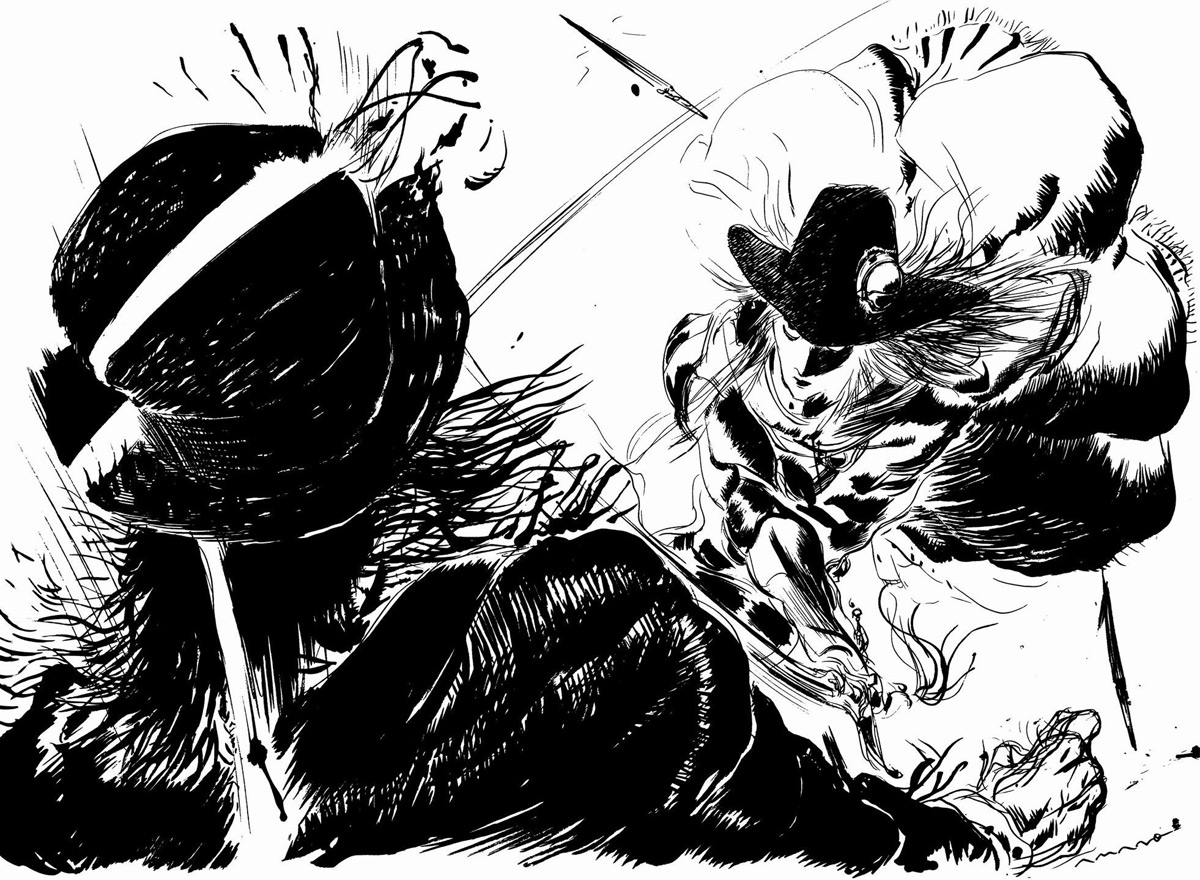
Or as Gully Foyle tries to start a fire in space in The Stars My Destination. (Love those short Bester paragraphs!)
He tried matches.
Matches will not burn in the vacuum of space.
He tried flint and steel.
Sparks will not glow in the absolute zero of space.
In M. John Harrison’s Light, the technique is used for the delivery of philosophical claims that aren’t limited to the present moment.
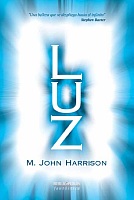
(Note that this passage happens immediately after a flashback ends:)
Kearney stared around him, uncertain for a moment where he was. Light will transform anything: a plastic drinking glass full of mineral water, the hairs on the back of your hand, the wing of an airliner thirty thousand feet above the Atlantic. All these things can be redeemed and become for a time essentially themselves. The cabin crew had begun to run up and down the aisles, emptying the seatback trays. Shortly afterwards the engines began to throttle up and then down again, as the aircraft banked and slipped down into the cloud. Vapour roiled in the wingtip turbulence, then the runway was visible, and the illuminated day transformed itself suddenly into the wet, windswept spaces of London Heathrow.
See how the latter half of the paragraph shows the ‘eternal’ claim of the first half in action?
Now let’s look at some more unusual uses of this device.

Mary Gentle for the win
Let’s turn to Mary Gentle’s (fucking amazing) Rats and Gargoyles, which is written in past for the most part but occasionally breaks from it. Gentle sometimes uses a Cut to Present as a scene starter, perhaps to create a sense of scenic timelessness that is then broken by action. You could call this a kind of “establishing shot,” I guess?
A distant clock chimes.
Blazing white light reflected from pale gravel and a pale sky.
Zar-bettu-zekigal sprawled on the fountain’s marble rim, knees and black dress spread apart, nostrils flaring to smell the day’s heat.
[From here, the scene continues in past tense]
Also, Gentle uses the move as a scene ender, to heighten tension and showcase the extraordinary:
A great intake of breath sounded around him, a simultaneous sound from the thousands gathered. Like wind across a cornfield, faces tipped up to the sky, ignoring the building-site and the foundation stone. Lucas raised his head, the corners of his vision filling with yellow dazzles.
Brilliant blackness stabbed his vision. Ringed with a corona of black flames, a black sun hung at the apex of the sky.
All the sky from arch to horizon glows yellow as ancient parchment. The twelfth chime of noon dies. Transmuted, transformed, in a fire of darkness: the Night Sun shines.
it's on

I think this technique can create a kind of naturalistic effect, a momentary pause from the action so the environment can seep into the scene. Maybe the effect on the viewer is similar to that of what Scott McCloud, in Understanding Comics, calls the aspect-to-aspect transition…
I’ve also seen the Cut to Present used subtly & briefly to introduce a magical effect.
He blinked. There was a sudden breath of chill on him and his eyes were blurring — no, no, it was the ship that wavered, ship and men fading — he clutched at Chryseis. She laughed softly and slipped an arm around his waist.
“It is only Shorzon’s spell,” she said. “It affects us too, to some extent. And it makes the ship invisible to anyone within seeing range.”
Ghost ship, ghost crew, slipping over the slowly heaving waters. There was only the foggiest outline to be seen, shadow of mast and rigging against the sky, glimpses of water through the gray smoke of the hull, blobs of darkness that were the crewmen…
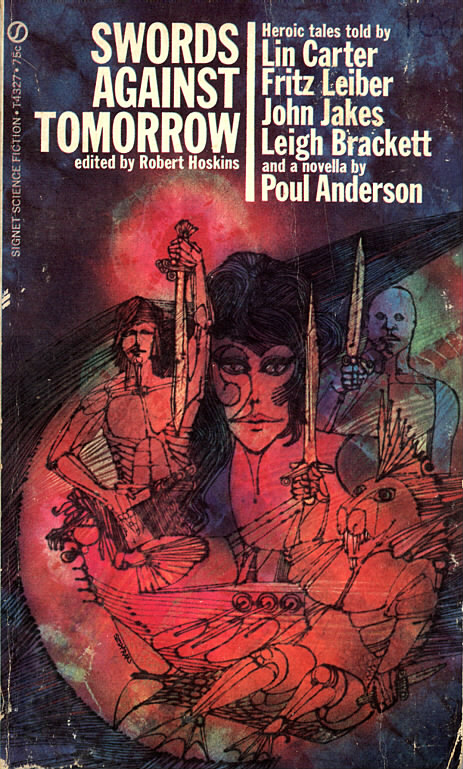
I’ve taken this example from Poul Anderson‘s novella “Demon Journey,” which I found in the very retro, very sexist, very derivative, very fun 1970 anthology Swords Against Tomorrow. (Robert Hoskins, ed.)
Because it creates a subtle effect of time distortion, the Cut to Present can also be used to signal that a flashback is approaching. Watch how M John Harrison (god, I’m really leaning on this guy for examples) does this in his gnostic horror novel The Course of the Heart.
Here the Cut to Present takes us out of the current scene — or maybe on the contrary deeper into the current scene — signaling, in any case, that the current order of things has been interrupted and that the story is now going in a different direction:
She watched the steam rising from her coffee cup, first slowly and then with a rapid plaiting motion as it was caught by some tiny draught. Eddies form and break on the surface of a deep, smooth river. A slow coil, a sudden whirl. What was tranquil is revealed as a mass of complications that can be resolved only as motion.
I remembered when I had first met her:
She was twenty then, a small, excitable, attractive girl…
I also found an interesting instance of the Cut to Present— too long to quote at length, unfortunately — in John le Carré’s The Honourable Schoolboy.
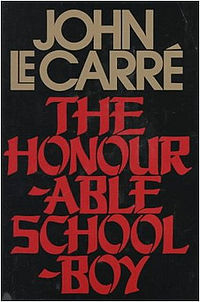
Without summarizing the plot, near the midpoint of the story, there’s a critical meeting where George Smiley & company synthesize the evidence and come to a conclusion that will drive the rest of the story.
Le Carre relates the whole scene in present tense, an exception in his mostly past-tense novel.
Why?
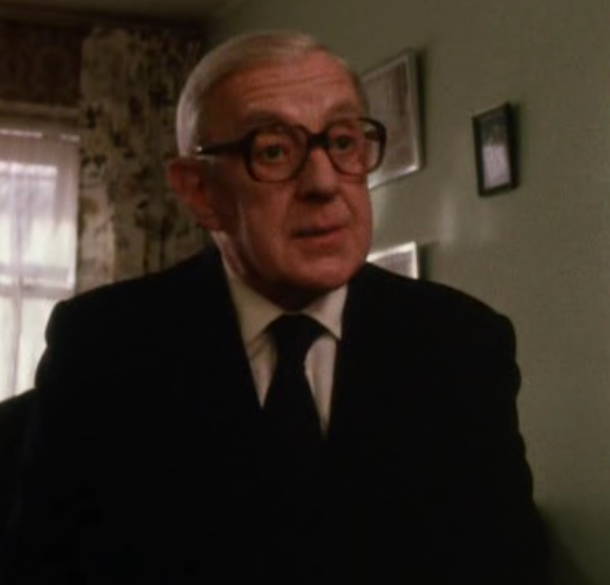
even better in this role than Gary Oldman
Maybe le Carré does this because what we read in the past tense is we perceive as “already finished.” The fact that it’s happened and we’re able to hear about it now creates a sense of completion and safety.
We sense this on a very basic level — for the same reason that we know a first-person story told in the past tense probably won’t end with the death of the POV character. (Otherwise the end of the story would have to bust out some serious gymnastics to convey how we’re getting the story “NOW.”)
So if you buy this theory of mine — and it is only a theory — I think the reason Le Carre wrote the turning point of The Honourable Schoolboy in the present tense was to deprive his readers of that sense of safety you get reading a past-tense tale.For a few critical moments at MI6, nobody in the crew knows what’ll happen next. By means of an extended Cut to Present, Le Carre reproduces that unease in the formal structure of his story.
If you’re a beginning writer who hasn’t mastered the basics of tense control, work on that first. It’s pointless trying to use this technique if you can’t stop yourself from doing it by accident.
But once you’ve gotten to the point as a writer where you no longer have trouble keeping tense consistent, push yourself by trying out the Cut to Present.
See you tomorrow at SpecTechnique!
Filed under: MICRO-MANAGEMENT, STRUCTURE, WRITING STYLE | 5 Comments
Tags: alfred bester, john le carre, M John Harrison, Mary Gentle, poul anderson, vampire hunter d
 SpecTechnique